Some Important Points
Towards the end of the last year, many healastro.com readers wrote about Dev Uthani Ekadashi and the Tulsi Vivah season that follows it. Utpanna Ekadashi is comparatively quieter. The festive season that follows from Tulsi Vivah with Diwali and other regional festivals is much awaited. However, for many Vaishnav families, this Ekadashi is observed more strictly as compared to the other religious festivals. Maybe your mom or nani skips grains one day every month. Ask her which Ekadashi she means when she says “yeh wali asli hai” (this is the real one), and odds are it is this one.
Not sure how strict your fast should be with the routine you have this month? One of our astrologers will discuss the details with you.
Utpanna Ekadashi is the Ekadashi fast that is kept in the Krishna Paksha of the Margashirsha month. According to the legends, once Lord Vishnu took rest and the demon Mura disturbed Lord Vishnu's peace and also troubled the Goddess Ekadashi. However, Goddess Ekadashi killed the demon Mura and restored the peace and Lord Vishnu's rest. It is believed that Utpanna Ekadashi is the root of all Ekadashi vrat. Generally, a no-grains fast is kept throughout the day, the katha is read in the evening and the Parana is done the next day.
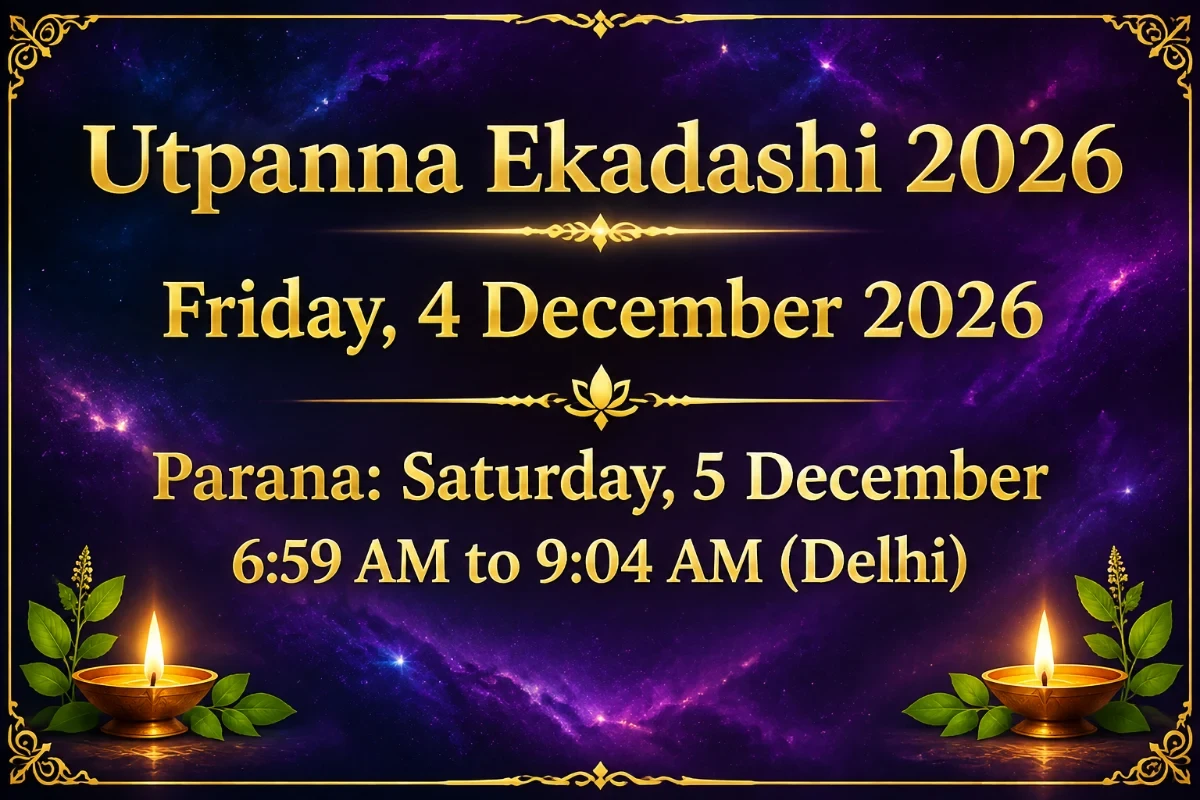
In the year 2026, Utpanna Ekadashi is celebrated on 4th December of the Krishna Paksha of the month of Margashirsha and the parana is done the next day which is 5th December, 2026. For the people of Delhi the parana window is from 6:59 AM to 9:04 AM. We checked this information with two different panchang and with Drik Panchang before posting.
The time window moves a little according to the local sunrise, so if you are not in the NCR (Delhi, Noida, Ghaziabad, Gurgaon, Faridabad) area, it is worth checking the panchang for your city instead of using the time frame below. If you are tracking the entire month, you can find other fasting days for this month on our upvaas calendar.
| Detail | Date and Time |
|---|---|
| Ekadashi | Friday, December 4, 2026 |
| Paksha and Month | Krishna Paksha of Margashirsha |
| Parana | Saturday, December 5, 2026 |
| Parana Time (Delhi) | 6:59 AM to 9:04 AM |
| Type of Vrat | Nirjala or Phalahari, as personally convenient. |

All Ekadashis have a story associated with them. This one is the foundation for all others. Padma Purana says that a demon by the name Mura, son of Nadi Jangam, forced the Devas to flee from their abode and took over the three worlds. The Devas went to Vishnu for help. This was not a brief battle. There are descriptions of a battle that took over a thousand years. Finally, Vishnu withdrew to the Badarikashram cave to take rest.
It is said that Mura once followed Vishnu to the place where he rested and tried to attack him while he was asleep. But, this part is the most interesting. From Vishnu’s body, a divine power or a shakti arose, and fought Mura on his behalf. This shakti finally killed Mura. Vishnu, on waking up, was pleased with this and offered her a boon. As she arose on the 11th day of the lunar fortnight, he gave her the name Ekadashi and also said that, from then on, if one kept a fast on this day, it would cleanse all their sins. This is why it is known as Utpanna Ekadashi.
It is believed that the starting point for all Ekadashi vrat is this Utpanna Ekadashi, and this is explained by Krishna to Arjuna in the Padma Purana. We have seen some websites mention this as ‘fun’ or ‘trivia’ facts and not important details. We’d say this is important as in the Hindu tradition, this is not just one of 24 Ekadashi vrat; it is the reason for the existence of all the 24 Ekadashi vrat and that’s why a lot of families consider this Ekadashi as important as Diwali or Tulsi Vivah Ekadashi.
The story has a practical side as well. Vishnu takes rest in the middle of the war, so even in the Puranas the strongest one gets tired. And the one who ends the fight isn't called in from outside; she is born from him. People ask our astrologers all the time which Ekadashi ‘counts’ more. Our answer: this one isn't about ranking, it's about where things began. Utpanna comes first in the cycle of twenty-four. That makes it the first, not the biggest.
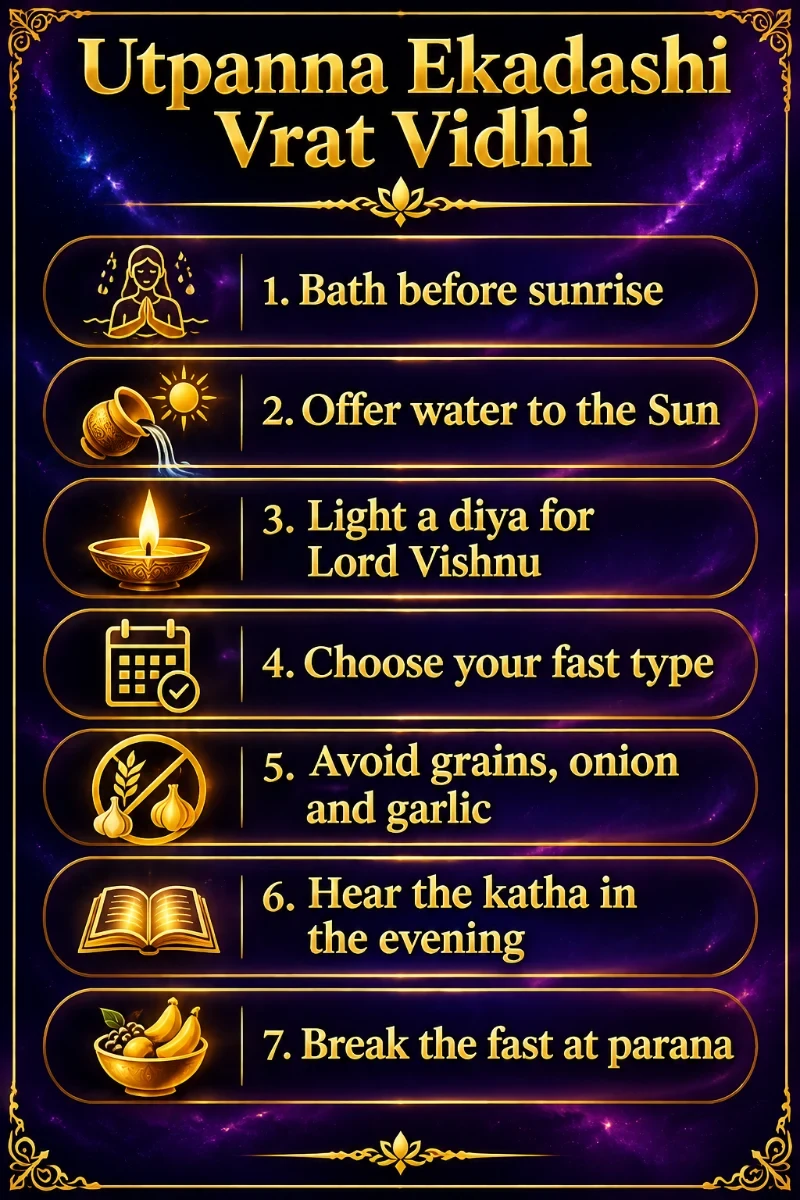
How strict people are with this vrat differs a lot from home to home. Still, in the Vaishnav households we've talked to, the day itself runs along pretty much the same lines. A good number of readers let us know they check their janmakundali or consult their horoscope before strictly observing a vrat, especially if the day is likely to be labor intensive.
Nobody gets it perfect. We know people who have kept a strict nirjala vrat every month for decades. We also know people who eat one simple meal and still feel the day meant something.
| Myth | Fact |
|---|---|
| You can't drink water at all. | Water is usually allowed; it's only in a strict nirjala fast that it's omitted. |
| Only rice is forbidden. | Traditionally all grains and legumes are omitted. |
| Skipping the fast once brings bad luck. | No classical text frames a missed Ekadashi as bringing bad luck. |
| The fast is for older family members only. | It can be adapted based on a person's health; our astrologers often suggest a simpler version of the fast for younger people and those who are unwell. |
| Strict fasting is recommended for expectant mothers and others who are unwell. | They shouldn't. Fasting can always be modified or skipped if a doctor recommends it. |
Utpanna Ekadashi is not a complicated day, however, there are a few add ons. Saying the Vishnu Sahasranama or chanting “Om Namo Narayanaya” is a practice followed widely. Also, it is a practice to chant the Mahamrityunjay mantra if someone in the household is ill. You can learn more about the mantra and how to chant it if this is new to you. Lighting a ghee diya at the tulsi plant is also a practice that most households follow. It is also suggested to perform a grah shanti puja along with performing the vrats to relieve the dosha if it is adding stress to a person.
These practices of faith are followed by many. A lot of online content promises fasts and mantra that will help in a person's career or health. Discipline and quiet is what many look forward to on this day more than what most people look forward to on loud festivals.
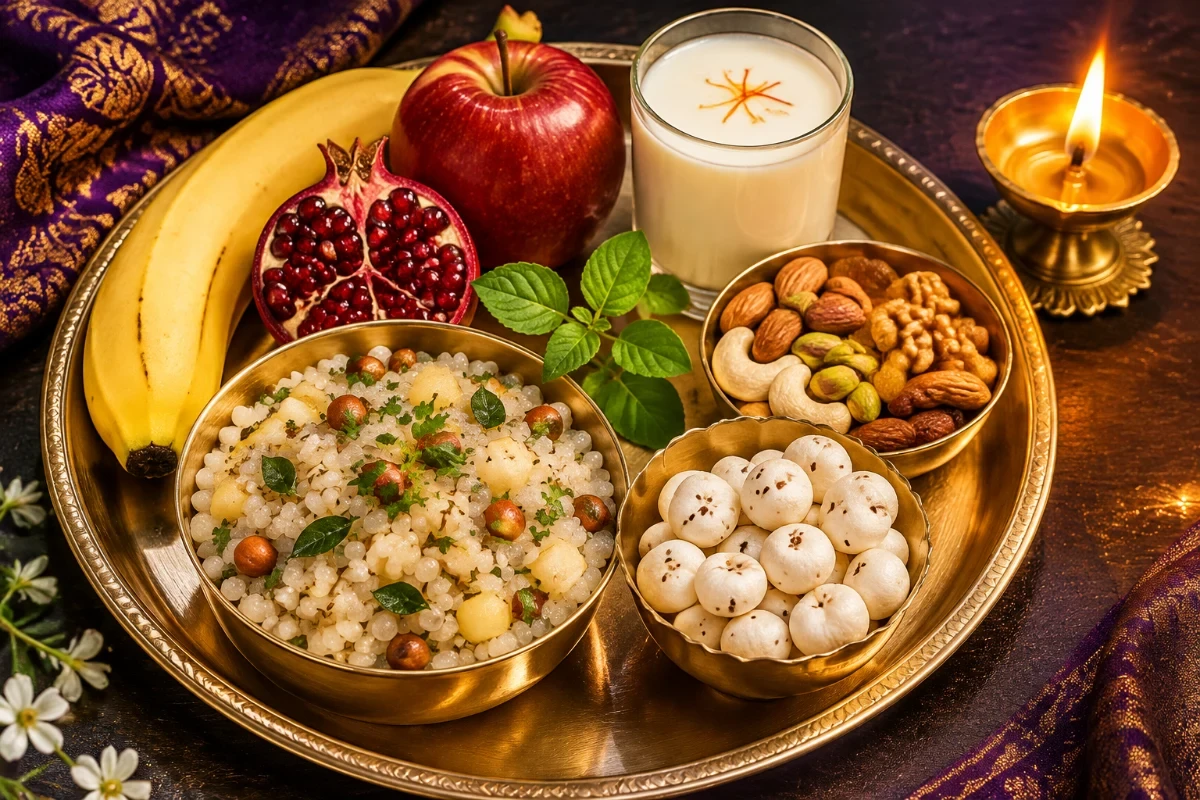
This example is illustrative, not a true case study. Let's say a reader in Pune has a full work day on December 4. They have back-to-back meetings, and a long commute both ways. There is no way they can manage a strict nirjala fast. A phalahari fast would be better in this case. As always, when needed, water can be taken. The rule of not consuming grains can be adhered to. A simple dinner of sabudana khichdi can be made. Traditionally, parana can be done on the way to work, and breakfast can be packed to be eaten on the desk. There is no rule that says breakfast has to be eaten at home. Breakfast can certainly be eaten at the desk. In this case, tradition has allowed for an adjustment.
If you have no help with the vidhi, our astrologers are available to conduct online consultations, where they can go over everything like they would if they were with you in person. Distance is not an issue for us.
Utpanna Ekadashi 2026 is observed on Friday, December 4, in the Krishna Paksha of the Margashirsha month, with parana on December 5.
This states that Goddess Ekadashi, who emerged from Lord Vishnu, defeated the demon Mura when Lord Vishnu took rest after a long battle. This is considered as the beginning of all Ekadashi vrat.
For people in Delhi, the parana time is approx. 6:59 AM to 9:04 AM IST on December 5, 2026. Note that parana time may slightly vary from place to place, hence check your local panchang for accurate timings.
Generally, food items that contain rice, wheat, lentils, onion and garlic are avoided and people stick to a fruit or nut based diet and/or a grain-free diet based on how strictly they wish to observe the vrat.
As per the Padma Purana, Lord Krishna told Arjuna about this Ekadashi and how it is the foundation of all Ekadashi vrat, and hence is considered first Ekadashi.
According to the classical texts, yes, rice along with wheat, lentils, etc are to be avoided on Ekadashi.
Yes. People with a full workday perform a phalahari fast with the restraint of fruits, milk and nuts, and avoid grains. The fast does not break with the intent of the vrat. Timing of meals can be adjusted to work around office hours.
No classical text describes a consequence of missing a vrat. Skipping a vrat is not the same as not praying. Devotion and fasting are intertwined, but the former always takes precedence over the latter.
Utpanna Ekadashi asks for a day of restraint and a story worth remembering, not a long list of mundane rituals. A fast and a katha is all it takes. Our astrologers can help you figure out the exact process and timing for a Negative Energy Mukti Havan, and answer any other questions you may have regarding regular vrat dosh puja. We also offer vrat Seva. For ongoing guidance throughout the month, the HealAstro app has a lot of features including consultation bookings, your horoscope and panchang.
Disclaimer: Astrology is not a replacement for medical, legal, financial, or psychological services. It is not fortunetelling, and no astrologer can guarantee a specific outcome.