Key points at a glance
The rishta looks good. The kundli milan score is 27 out of 36, both families are comfortable, and then an elderly relative says, "Navamsa bhi dekh lo." Suddenly nobody knows what that means. If this is your house right now, you are not alone. Most of the families who write to us ask about the guna score and stop there. Our astrologers read the kundali matching guide results first, but a serious marriage reading is never complete until the navamsa chart has been checked too. This guide shows you how to read it yourself, and where a self-reading should stop.
Get your marriage chart read by a HealAstro astrologer
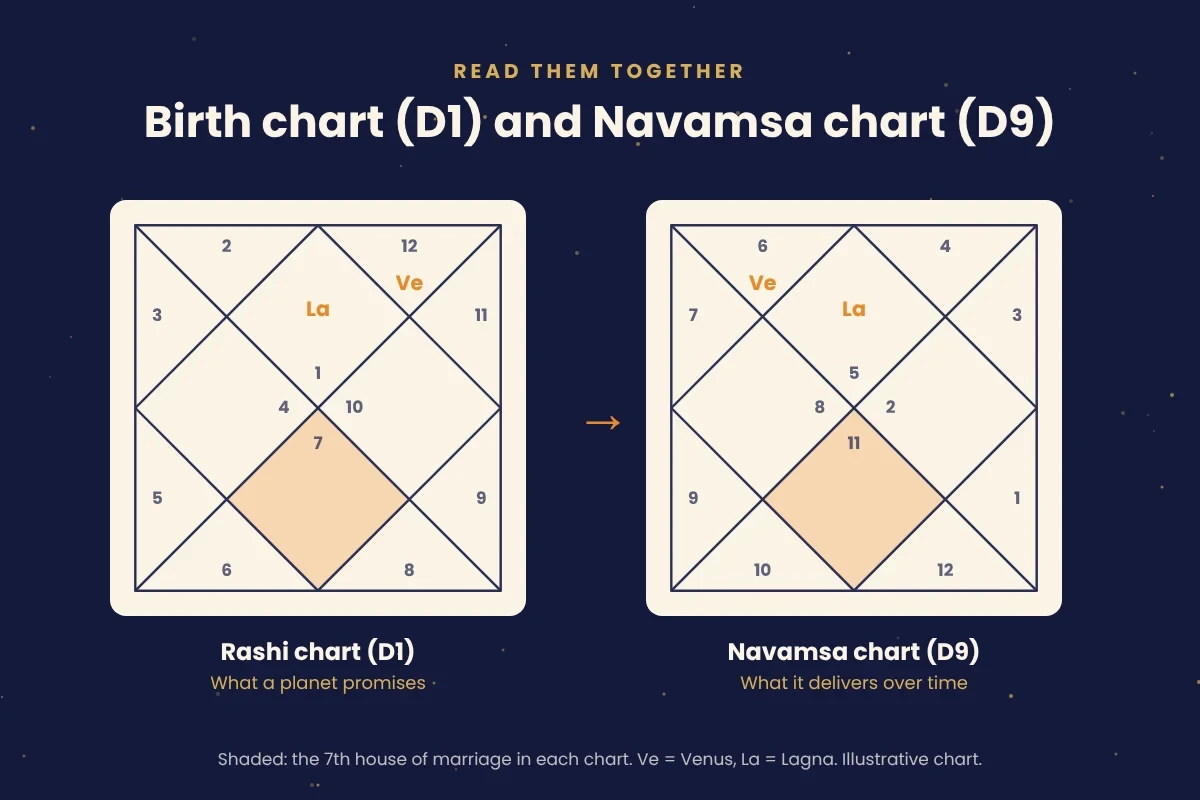
A navamsa chart is the D9 divisional chart in Vedic astrology. It divides each of the 12 signs into nine equal parts of 3°20′, giving 108 navamsas in the zodiac, and it is used to judge a planet's inner strength and the quality of marriage and dharma in a person's life.
The word "navamsa" means one-ninth. Brihat Parashara Hora Shastra (BPHS), the classical text most Vedic astrologers follow, treats the D9 as one of the most important divisional charts, and in practice it is the one astrologers consult right after the birth chart (rashi chart, D1). Think of D1 as the visible house and D9 as its foundation. The house may look grand, but the foundation decides how it stands after ten or twenty years.
The navamsa chart matters for marriage because the D9 shows what a planet delivers over time, while the birth chart shows what it promises at the start.
Many sites say that D9 is only a "backup" chart and that the 7th house of the birth chart does all the work. We disagree. A chart can have a lovely D1 7th house while the D9 tells a different story about commitment, patience and adjustment after the wedding. The reverse happens too: a heavily loaded D1 with a calm, supportive D9, which reads as a hard first phase that settles with time.
Phaladeepika and BPHS both link the navamsa with the spouse and with the planets' real strength. That is why classical astrologers rarely finish a marriage reading without it. If you are still at the stage of asking whether a marriage is likely at all, start with our article on marriage prediction by date of birth and then come back to the D9 for the detail.
The way to read a navamsa chart is to place the planets in the D9 correctly, compare each one with its birth-chart sign, and then study the 7th house, its lord and Venus.
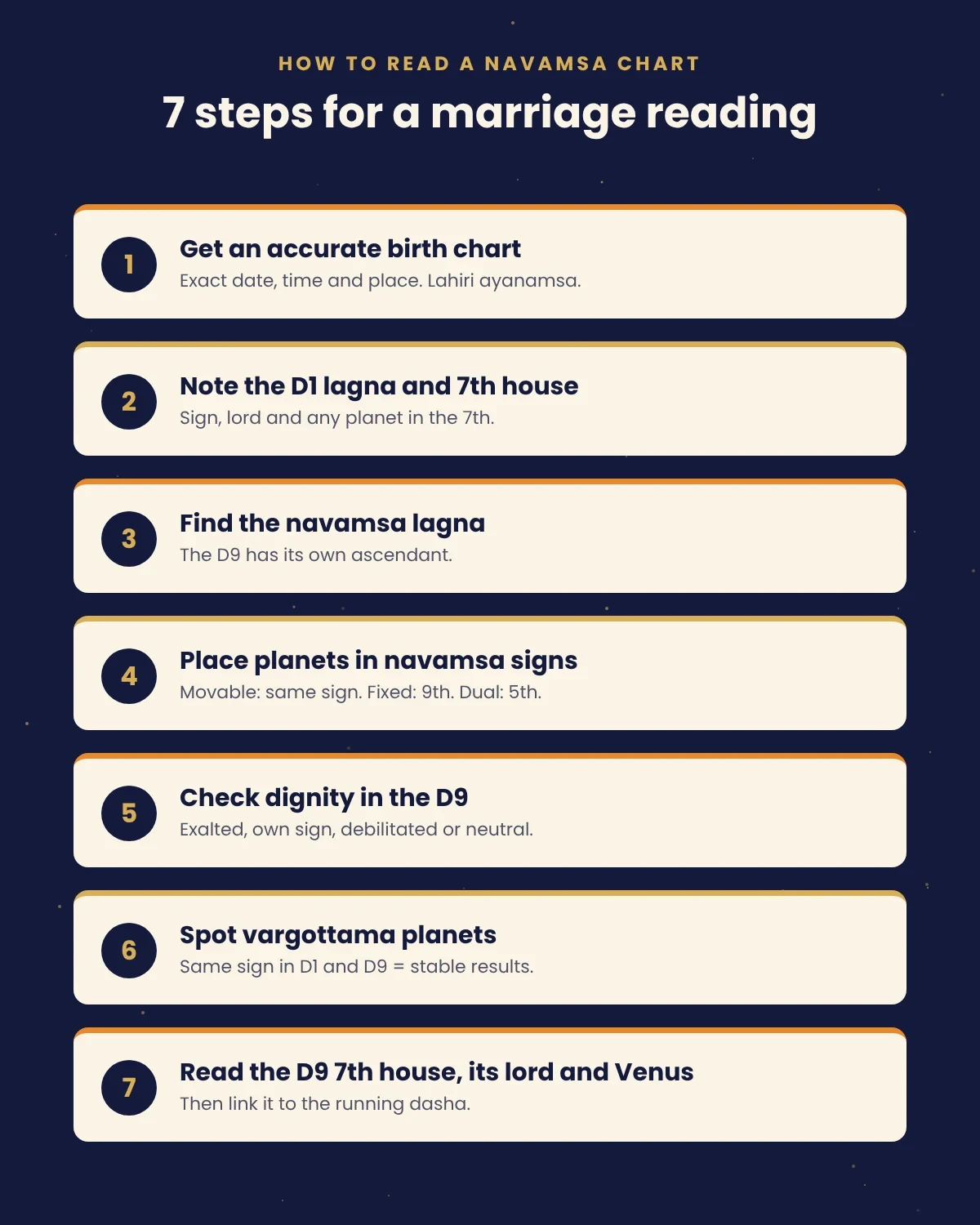
Here is the quick reference for Step 4:
| Sign type | Signs | First navamsa begins from |
|---|---|---|
| Movable (chara) | Aries, Cancer, Libra, Capricorn | The same sign |
| Fixed (sthira) | Taurus, Leo, Scorpio, Aquarius | The 9th sign from it |
| Dual (dwiswabhava) | Gemini, Virgo, Sagittarius, Pisces | The 5th sign from it |
So a planet at 2° of Aries falls in Aries navamsa, and a planet at 2° of Taurus falls in Capricorn navamsa. Each next 3°20′ moves to the next sign in order.
Check your own marriage chart with a Marriage Compatibility Report
For marriage, the key places in the D9 are the 7th house, the 7th lord, Venus and the navamsa lagna, and each one answers a different question.
The 7th house of the navamsa chart describes the nature of the partnership as it matures. A benefic here, such as Jupiter or Venus, usually points to warmth and a supportive spouse. Saturn here often suggests a later or slower marriage with a serious, responsible partner. Rahu in the 7th of the D9 can bring an unconventional partner or a marriage that looks different from what the family imagined.
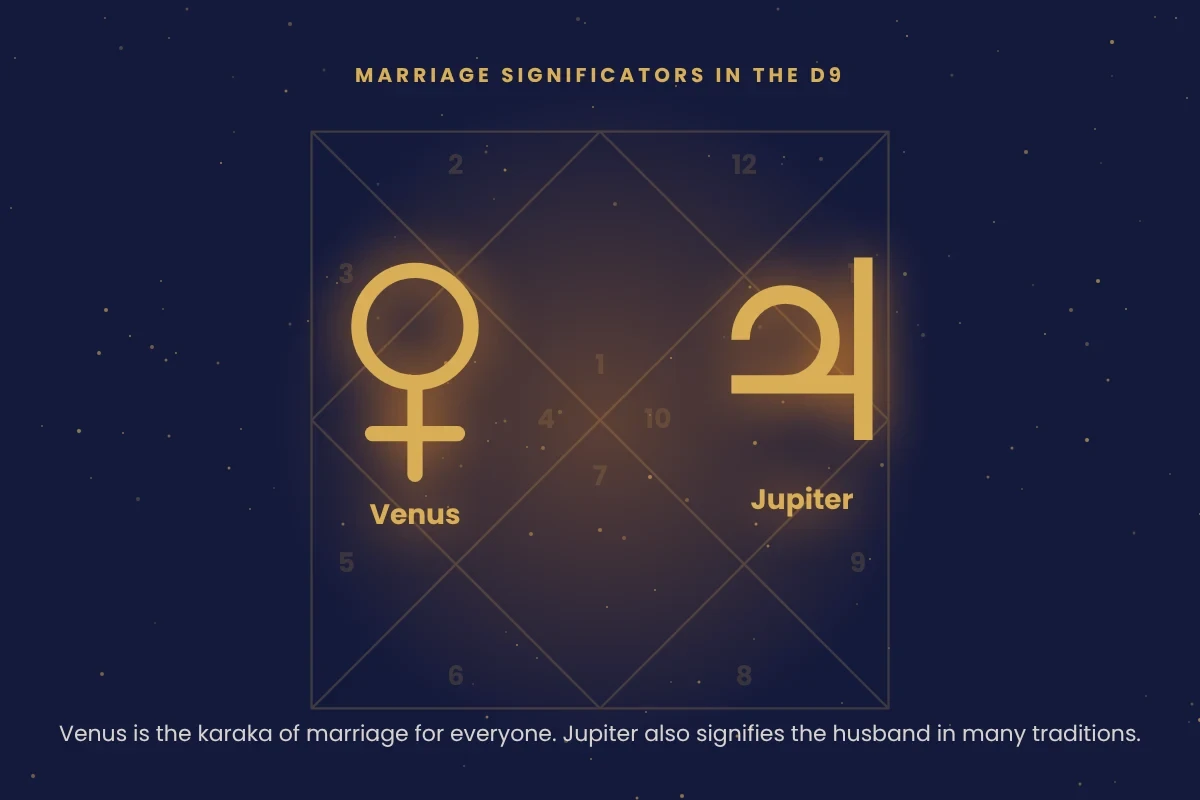
Venus is the natural significator (karaka) of marriage for everyone, and Jupiter takes that role for women in many classical traditions. If Venus is exalted or in its own sign in the D9, it supports affection and harmony. If it is debilitated in the D9 but strong in the birth chart, we read that as a promise that needs work after marriage, not as a denial.
The navamsa lagna shows how you carry yourself inside the marriage. Its lord, and the sign it occupies in D1, tell us whether your own temperament helps or strains the bond. We often find this is the missing piece when two people with a strong guna score still struggle to adjust.
A good D9 does nothing without timing. We look at the Venus, Jupiter and 7th-lord periods, and at the dasha running when marriage is discussed. If your wedding has been delayed, read our guide on late marriage in kundli next, because the D9 explains the quality of the marriage and the dasha explains the delay.
A vargottama planet is one that occupies the same sign in the birth chart and in the navamsa chart, and it is treated as having extra stability.
A vargottama Venus or Jupiter is a lovely thing to find. Yet vargottama alone does not make a chart good. A vargottama debilitated planet is steady in its weakness. Our astrologers also look at which house the planet rules and where it sits, before calling it a strength.
The more common situation is a swap. A planet strong in D1 but weak in D9 gives a good start that needs effort to maintain. A planet weak in D1 but strong in D9 starts slowly and improves with age and maturity. Neither is a verdict. Both are directions.
This is an illustrative example, not a real client.
Take a woman with Aries lagna and Venus at 8° of Pisces. In the birth chart, Venus is exalted, which looks excellent for love and marriage. Pisces is a dual sign, so its first navamsa starts from the 5th sign, Cancer. The nine parts run Cancer, Leo, Virgo and so on, and 8° falls in the third part, which is Virgo. Venus is debilitated in Virgo, so in the D9 it is weak.
A quick reader would say "exalted Venus, great marriage". A D9 reader says something more careful: the attraction and the early understanding are likely to be good, but day-to-day adjustment, practical expectations and criticism between partners need attention. That is not a fear tactic. It is useful information, because a couple who know this in advance can talk about expectations before the wedding and not after it. We would then check the 7th lord in D9 and the current dasha before saying anything stronger.
| Myth | Fact |
|---|---|
| The navamsa chart replaces the birth chart. | It adds detail to the birth chart. Both are read together. |
| A weak D9 means a failed marriage. | It shows where effort is needed. No chart can promise or rule out a happy marriage. |
| Vargottama always means good results. | It means stability. A weak planet stays weak. |
| You can read D9 without an exact birth time. | A change of about 13 minutes in birth time can move the navamsa lagna, so the time must be reliable. |
| A high guna score makes the D9 unnecessary. | The 36-point score compares two Moon positions. It does not examine each person's D9. |
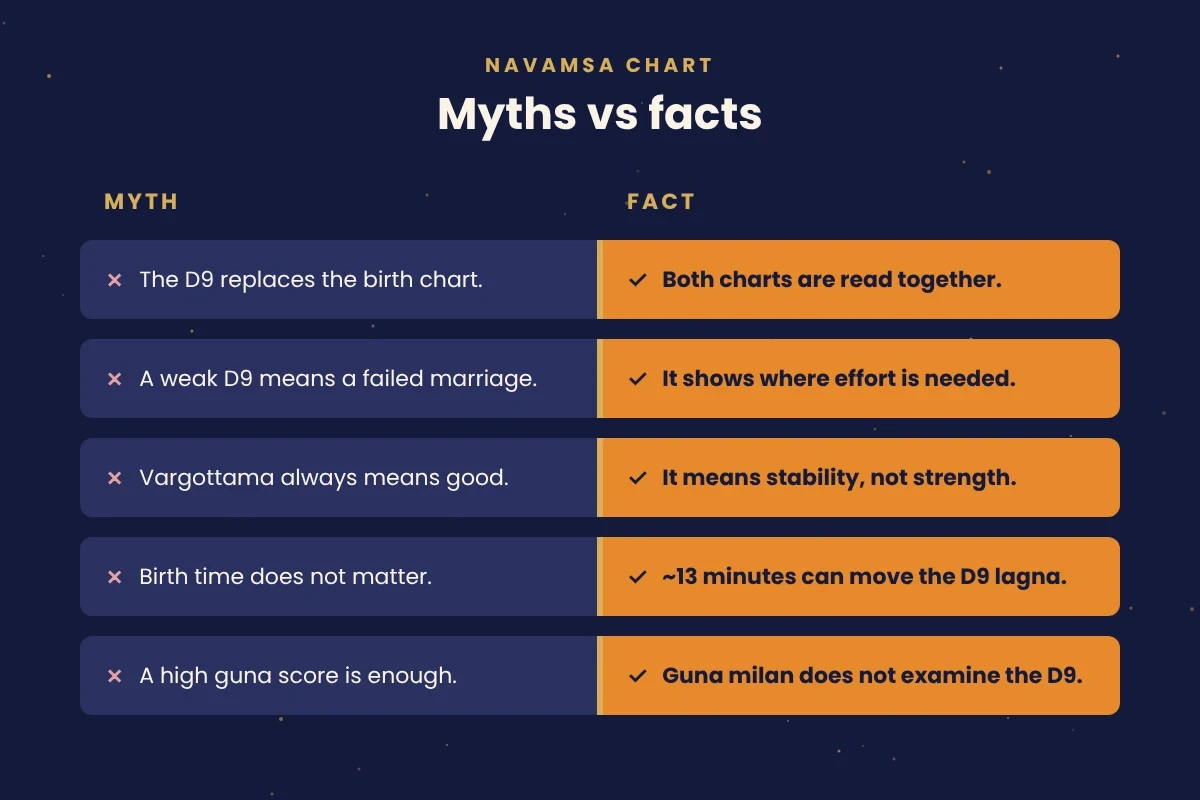
That last myth matters most in Indian families. A score of 30 or more feels like a green light, and it is a good sign. But kundli milan compares the Moon's nakshatra and a few factors. It does not replace a look at both partners' navamsa charts.
Remedies for a weak navamsa chart are traditional practices and acts of faith, and they cannot guarantee any result.
Nothing here replaces honest conversation between the two people involved, or a doctor or counsellor if the issue is health or mental wellbeing.
Online consultation works just as well as an in-person visit for a navamsa chart reading, because the chart depends on your birth data and not on where you sit.
Readers from Delhi NCR, Mumbai, Jaipur, Lucknow, Pune, Bengaluru and Ahmedabad write to us regularly, often right after a family meeting or before a roka. Many of them have already collected kundlis from two or three pandits, and the readings do not match. Usually the difference is the birth time used, or whether the D9 was looked at at all. Send your birth details once, and our astrologers will cast the D1 and D9 from the same data and explain where they agree.
For a faster start, use the chat with astrologers option for one specific question, or book a longer call if you are comparing two proposals.
A navamsa chart is the ninth divisional chart, called D9. It divides each zodiac sign into nine parts and shows how strong each planet is. We use it mainly to study marriage, the spouse and the deeper results of the planets in a birth chart.
Read the D9 after the birth chart. Check the 7th house of the navamsa chart, its lord, Venus, and the navamsa lagna. Then compare each planet's D9 sign with its D1 sign and match the findings with the current dasha. A professional reading saves you from guesswork.
No. The birth chart is the main chart and the navamsa chart supports it. In marriage readings we give the D9 equal attention, but we never judge a life from the D9 alone. Both charts are read together, with dashas and transits added on top.
Vargottama means a planet is in the same sign in the birth chart and the D9. It is considered stable and gives its results with more consistency. It does not make a weak or troublesome planet good, so we always check the planet's house and dignity as well.
Not reliably. The navamsa lagna can change in roughly 13 minutes of birth time, so a wrong time can give a wrong D9. If the time is uncertain, our astrologers may suggest a birth-time rectification or use methods that do not depend on the ascendant, with clear limits.
No. A weak Venus in the D9 points to areas needing effort, such as adjustment or expectations, not to a failed marriage. We look at Venus together with the 7th lord, Jupiter and the dasha. Remedies are acts of faith and no astrologer can guarantee an outcome.
It is useful. Basic kundli matching compares the two Moon positions and gives a score out of 36. A D9 comparison adds detail about each person's temperament and the strength of the 7th house, so we recommend it for serious proposals before roka or engagement.
A navamsa chart is easy to explain and hard to read well, because every planet, house and dasha affects the others. If you want your D9 and birth chart read together, you can book an astro consultation or order a Complete Kundli Report to keep your full chart analysis on record.
You can also take HealAstro with you on Android through the HealAstro app on Google Play.
Disclaimer: Astrology offers guidance based on traditional Vedic principles. It is not a substitute for medical, legal, financial or psychological advice, and no astrologer can guarantee an outcome.