Key points at a glance
Your rishta (marriage proposal) looks perfect. Good family, good job, both sides keen. Then the pandit reads the Ashta Koota sheet, goes quiet, and says "Nadi dosha hai." The whole room changes. If this is where your family is today, take a breath. This finding is one of the most misunderstood in kundali matching, and it is far less final than the first reaction suggests. Here is what it actually means, when it cancels, and what we tell families who walk in with this exact worry.
Check your Nadi with a free kundali matching report
It is a flaw recorded in Ashta Koota (the eight-factor matching system) when the boy and girl belong to the same Nadi, which is decided by their Moon nakshatra. Nadi carries the highest weight in the system, 8 of 36 points, and a same-Nadi pair scores zero on it. Traditionally it is linked with concerns about health compatibility and children.
Nadi is the last and heaviest of the eight kootas in Guna Milan (the 36-point compatibility score). Varna carries 1 point, Vashya 2, Tara 3, Yoni 4, Graha Maitri 5, Gana 6, Bhakoot 7 and Nadi 8. The weighting is not an accident. Classical matching texts treated Nadi as a pointer to physical constitution, and constitution was seen as the base for a healthy household and healthy children.
That is the traditional logic. We say it plainly because families should hear it at its real size. It is an old rule of thumb about constitution, not a medical test. If health or fertility is the worry, a doctor answers that. The kundli does not.
Every one of the 27 nakshatras sits in one of three Nadis, named after the Ayurvedic doshas they echo. Aadi Nadi relates to Vata, Madhya to Pitta, and Antya to Kapha. The table is the reference most families never get shown.
| Nadi | Ayurvedic link | Nakshatras |
|---|---|---|
| Aadi | Vata | Ashwini, Ardra, Punarvasu, Uttara Phalguni, Hasta, Jyeshtha, Moola, Shatabhisha, Purva Bhadrapada |
| Madhya | Pitta | Bharani, Mrigashira, Pushya, Purva Phalguni, Chitra, Anuradha, Purva Ashadha, Dhanishta, Uttara Bhadrapada |
| Antya | Kapha | Krittika, Rohini, Ashlesha, Magha, Swati, Vishakha, Uttara Ashadha, Shravana, Revati |
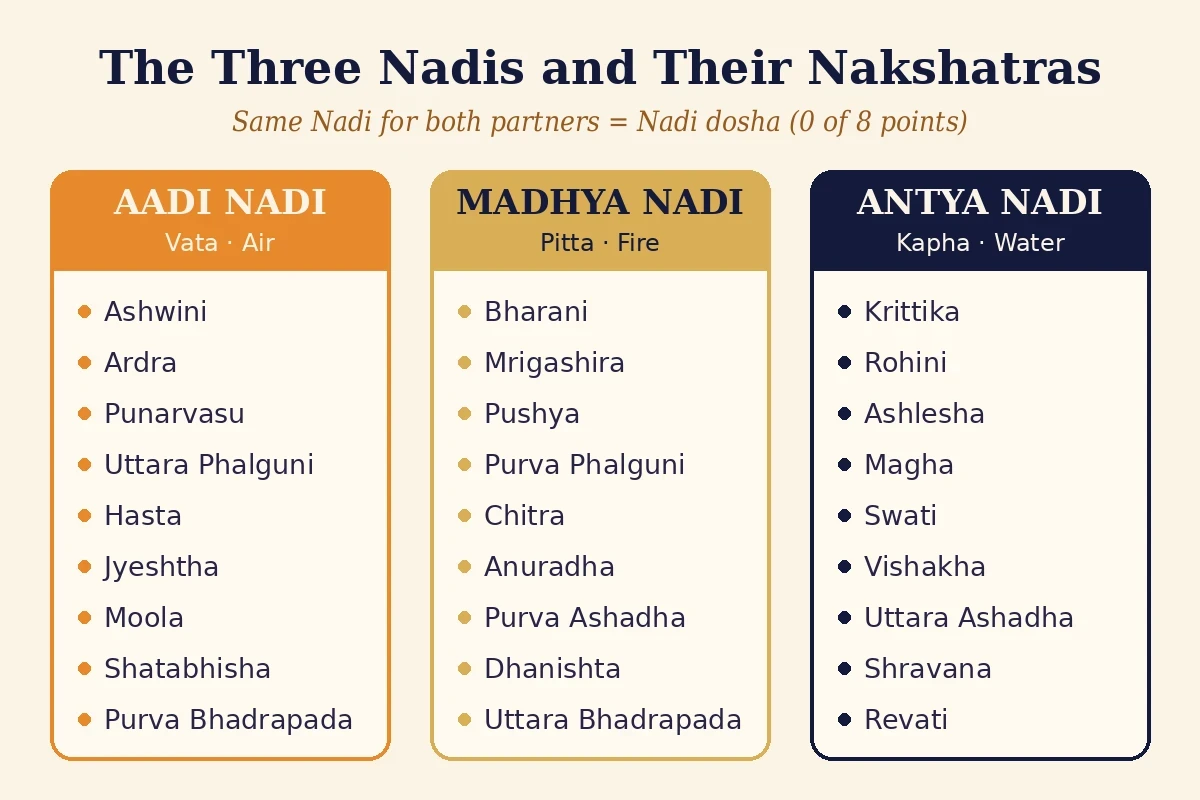
Read it like this. If his Moon is in Hasta and hers is in Moola, both are Aadi, so the dosha is present. If his Moon is in Hasta and hers is in Chitra, he is Aadi and she is Madhya, so there is no Nadi dosha.
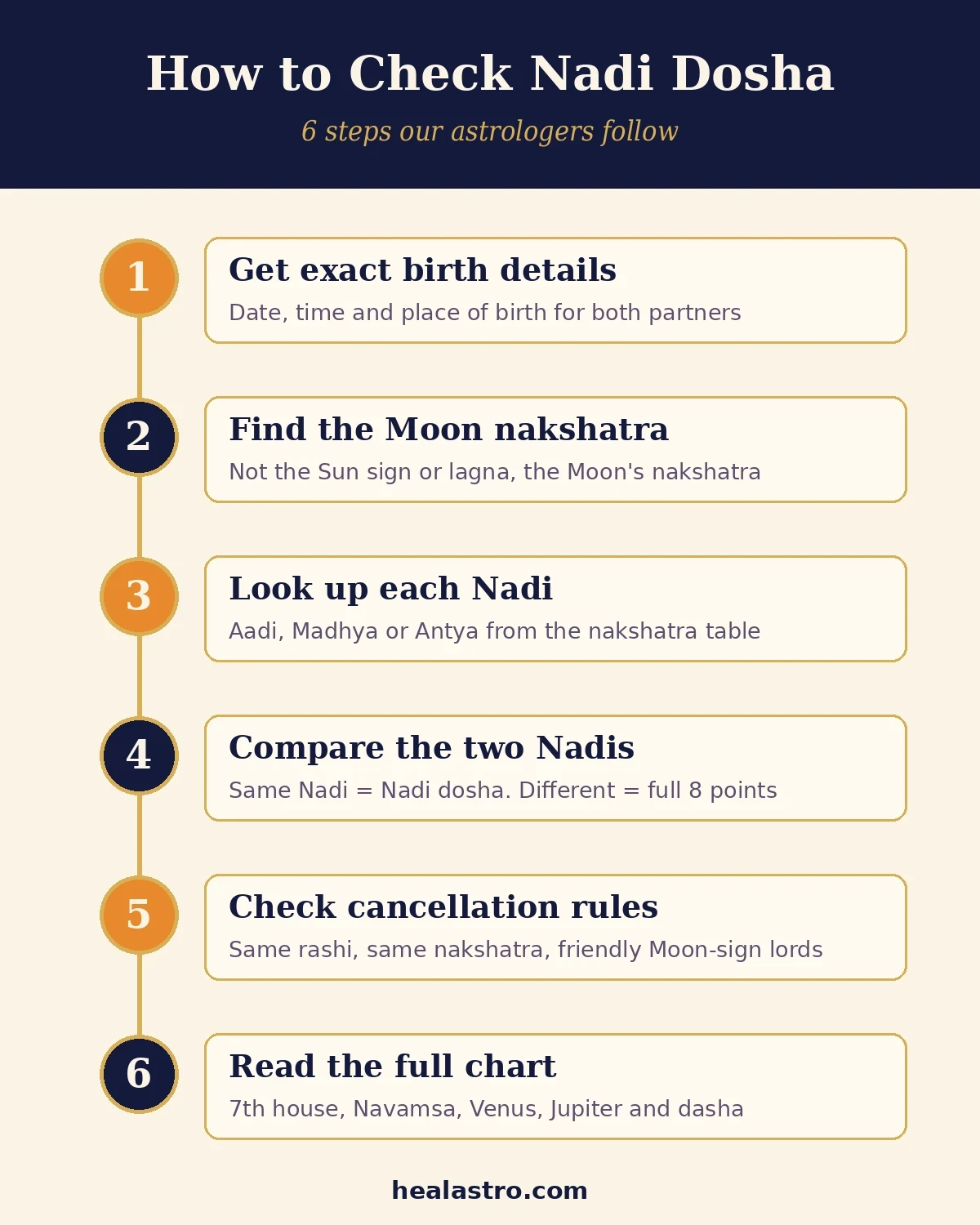
You need the Moon nakshatra of both partners, and that depends on an accurate birth time. Here is the method our astrologers follow.
Talk to our astrologers about your Nadi score
No. The flag does not mean the marriage will fail, and we disagree with any astrologer who says it does on the strength of a score sheet.
Many sites tell you a Nadi match is mandatory and a same-Nadi couple should walk away. We disagree, and here is why. Ashta Koota looks only at the two Moon positions. It cannot see Mars in the 7th, a strong Jupiter aspecting the house of marriage, or a Venus placed well in both charts. Two people can score 29 out of 36 with a Nadi clash and still have strong Navamsa support, while another pair scores 31 and has quiet trouble in the 7th house. Score is where the reading starts.
That said, we do not wave it away either. It is a real flag in the tradition, and many elders in a family will care about it. Our job is to tell you what the chart shows, then help you decide with open eyes.
Classical texts and later commentaries list conditions under which Nadi dosha is considered cancelled or much reduced. Astrologers do not all accept the same list, so treat these as the ones commonly cited, not as a universal rule.
Notice the pattern. Almost every condition asks you to look beyond the Nadi column. That is the real lesson. It is a flag to investigate, and the investigation lives in the rest of the horoscope. If you want the wider picture of how afflictions work, our guide to planetary doshas in a kundali explains how a dosha is weighed against the chart as a whole.
| Myth | Fact |
|---|---|
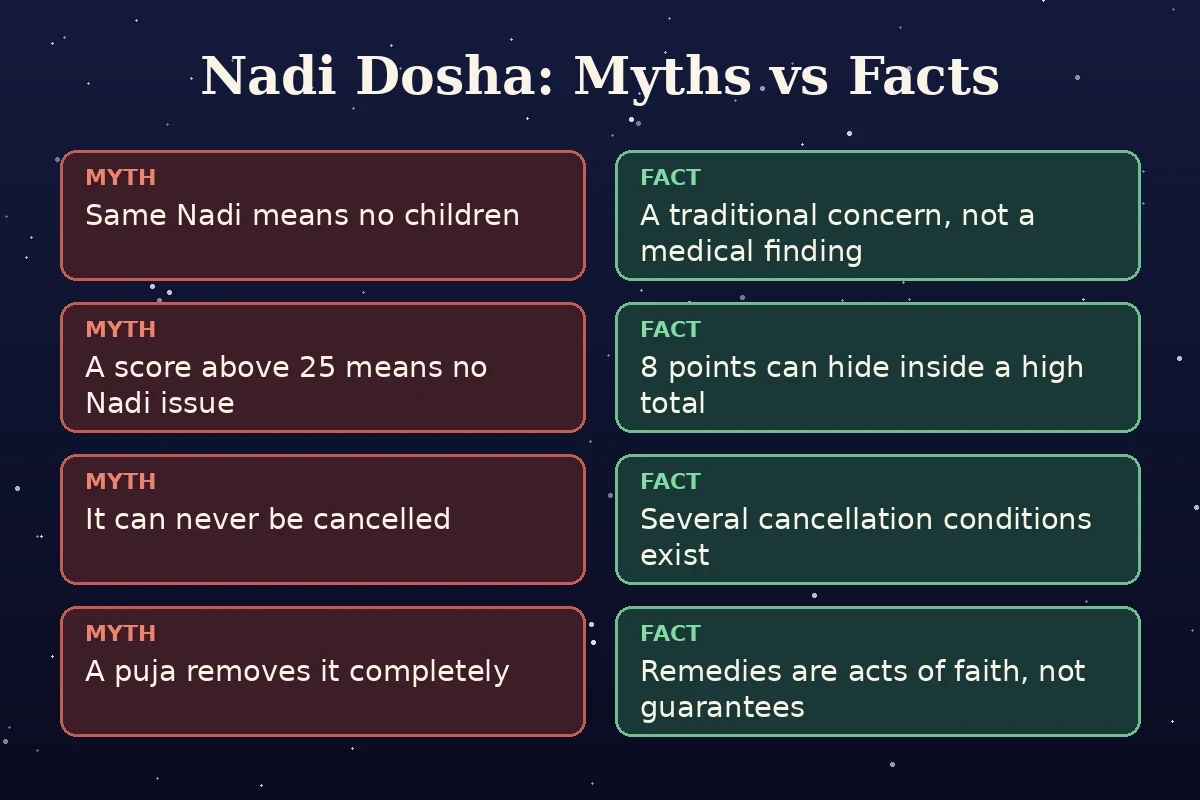
| Same Nadi means the couple cannot have children. | The tradition links it to concerns about health and progeny. It is not a medical finding, and a doctor answers fertility questions. |
| A score above 25 means there is no Nadi problem. | The 8 Nadi points can be lost inside a high total. Always read the Nadi column on its own. |
| It can never be cancelled. | Several cancellation conditions exist, though schools differ on which they accept. |
| Same gotra and same Nadi are the same thing. | Gotra is about lineage. Nadi is about the Moon's nakshatra. They are separate checks. |
| A remedy puja removes the dosha completely. | Remedies are traditional acts of faith. They cannot guarantee any outcome. |
| It is the same as Manglik dosha. | They are different. Manglik dosha comes from Mars, Nadi dosha from the Moon's nakshatra. |
This is an illustrative example, not a real client. We use it to show how our astrologers think.
Imagine a boy with Moon in Hasta (Aadi) and a girl with Moon in Moola (Aadi). The family in Jaipur comes with the sheet showing 27 out of 36, Nadi at zero, and the roka (engagement ceremony) already being planned. The first question is whether both birth times are accurate. Suppose they are. Then we check cancellation: Hasta falls in Virgo and Moola in Sagittarius, so the Moon signs differ, and the nakshatras differ, which the simpler cancellation rules do not cover. So we look wider. We examine the 7th house and its lord in both charts, the Navamsa (the D9 chart for marriage), Venus and Jupiter.
If the wider chart is supportive, we tell the family that the Nadi flag is real but is not the whole story, and that the final call is theirs. If it is not, we say that too, and we say it gently. That is the difference between a score sheet and a consultation.
An honest limitation first. Everything above depends on birth time. A 10 to 15 minute error can push the Moon into a different nakshatra pada, and near a boundary it can change the nakshatra itself and so the Nadi. If your birth time is a guess, the dosha might be real or an artefact. We always ask for the source of the time (hospital record, parent's memory, an old diary).
Second, the dosha tells you nothing about health that a doctor cannot tell you better. If a couple has real health or genetic concerns, get medical advice. Astrology is guidance, not diagnosis.
These are traditional practices. They are acts of faith and cannot guarantee any outcome. None of them replaces medical, legal or financial advice.
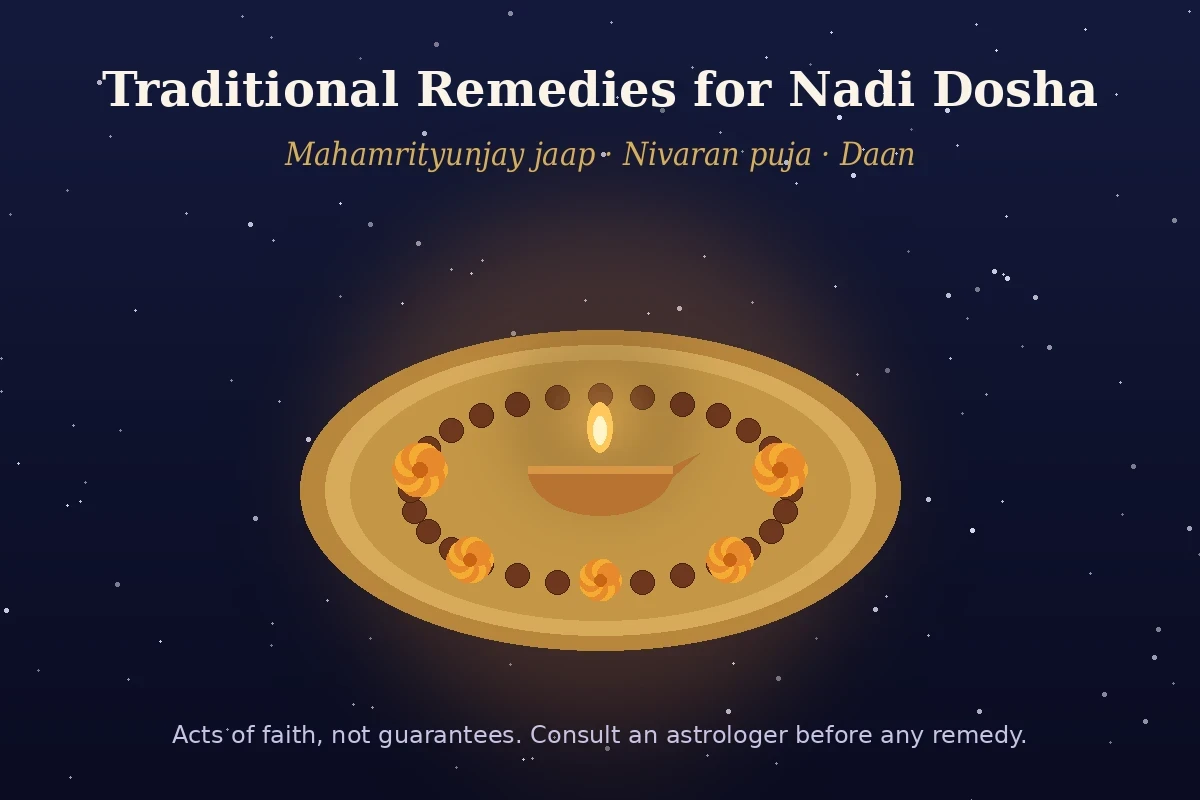
Be careful about anyone who quotes a high price for "complete removal" of Nadi dosha. No honest practitioner can promise that.
Families in Delhi NCR, Mumbai, Jaipur, Lucknow, Pune and Bengaluru ask us about Nadi dosha more than almost any other matching issue, usually in the weeks between the first meeting and the roka. Online consultation works just as well as an in-person visit. All an astrologer needs are the exact birth details of both people and a quiet half hour, and your kundli opens on our screen the same way it would on a table in a pandit's office. If your family is spread across cities, which is common, a single video or phone call can include everyone.
Get a Marriage Compatibility Report for your match
Nadi is one koota. Marriage in a chart also depends on the 7th house, its lord, the Navamsa and the running dasha (planetary period). Our guide to the 12 houses in Vedic astrology is a good place to see why the 7th house matters so much, and our piece on marriage prediction by date of birth shows how timing is read. A Nadi flag, a clean 7th house and a supportive dasha is a very different case from a Nadi flag plus a troubled 7th.
It is a matching flag that appears when both partners have the same Nadi. Nadi is set by the Moon's nakshatra, and there are three: Aadi, Madhya and Antya. Same Nadi means the Nadi koota scores zero out of 8 points, and the tradition links it with health and progeny concerns.
It costs 8 points out of 36, the largest share of any koota. A couple with a total of 28 might therefore have Nadi at zero and 28 elsewhere. Always check the Nadi column separately instead of relying on the total, because a high total can hide the clash.
Not by itself. Check cancellation conditions and the wider chart first. Many astrologers treat it as serious, and families differ in how much weight they give it. We advise reading the 7th house, Navamsa and dasha before deciding, and being honest about what the chart shows either way.
Yes, in some cases. Commonly cited conditions include the same Moon sign with different nakshatras, the same nakshatra with different Moon signs, and friendly Moon-sign lords. Astrologers do not all accept the same list, so a person reading your actual chart is better than any general rule.
The tradition links it with concerns about children, but astrology cannot diagnose fertility or health. If you have a medical worry, see a doctor. We use the kundli for guidance on compatibility and timing, and never as a substitute for medical advice.
Traditional remedies include Mahamrityunjay mantra jaap, a dosha nivaran puja before the wedding, and charity. These are acts of faith and cannot guarantee any result. Gemstones are suggested only after a chart check, and never as a quick fix for a matching score.
Many families check it even in love marriages, especially when elders are involved. Whether you follow it is your decision. A free kundali matching run takes a minute, and a consultation can tell you what the full chart says beyond the Nadi column.
Then the Nadi result may be unreliable. A small error can shift the Moon's nakshatra pada, and near a boundary it can change the nakshatra and so the Nadi. Bring the best record you have, and our astrologers can tell you how stable your Moon nakshatra is.
This is a flag, not a verdict. Run the matching, read the Nadi column, check the cancellation conditions, and then look at the 7th house, the Navamsa and the dasha before you decide anything. That is the order we follow with every family.
Book a Nadi dosha reading with our astrologers to go through both charts with someone who will tell you what they see. For a written, shareable analysis you can show elders, the Match Making Kundali Report puts it all in one place, and you can run quick checks any time on the HealAstro app.
Disclaimer: Astrology offers guidance based on traditional Vedic principles. It is not a substitute for medical, legal, financial or psychological advice, and no astrologer can guarantee an outcome.