Key points at a glance
The rishta looks right. Same city, similar families, the boy and girl got along on the first video call. Then the pandit reads both kundlis and says, "Bhakoot dosh hai." Parents go quiet. The grandmother starts calling relatives.
If that scene is familiar, this guide is for you. Bhakoot dosha is one of the most misunderstood items in kundali matching, and we have seen more good matches stalled by it than by almost anything else on the guna sheet.
Check your own Bhakoot score free with the HealAstro Kundali Matching tool
Bhakoot dosha is a mismatch flagged in kundli matching when the Moon signs (rashi) of the two people fall in a 6/8, 2/12 or 5/9 relationship counted from each other. In the 36-point Ashta Koota system, Bhakoot is worth 7 points, and these three pairings score zero. Traditionally it is read as a pointer to money, family comfort and mutual understanding.
Two things to hold on to. First, it is only about the Moon sign, not the whole chart. Second, "dosha" here means a weak spot to examine, not a curse.
Bhakoot is the second-heaviest koota after Nadi, which carries 8 points. If you want the Nadi side of the same sheet, our guide to Nadi dosha and its cancellation covers it.
The scoring is simple. Count from the boy's Moon sign to the girl's, and from the girl's back to the boy's. The two counts always add up to 14.
That is all the arithmetic there is. The interpretation is where opinions differ.
Each of the three pairings carries its own traditional reading, and they are not equally serious. Here is how our astrologers summarise them.
| Pairing | Sanskrit name | Traditional reading | How we treat it |
|---|---|---|---|
| 6/8 | Shadashtak | Friction, health strain, 'enemy' energy between the two | Look closely; most cancellations apply here |
| 2/12 | Dwirdwadash | Money pressure, spending, one partner carrying more | Check the lords and the 2nd and 12th houses |
| 5/9 | Nav-Pancham | Differences in outlook; old verses mention children | Often mild; the direction of the count matters |
Some old verses use harsh words for the 6/8 pairing. We do not read them literally, and we would not scare anyone with them. A pair of Moon signs cannot, on its own, decide whether two adults will respect each other for forty years.
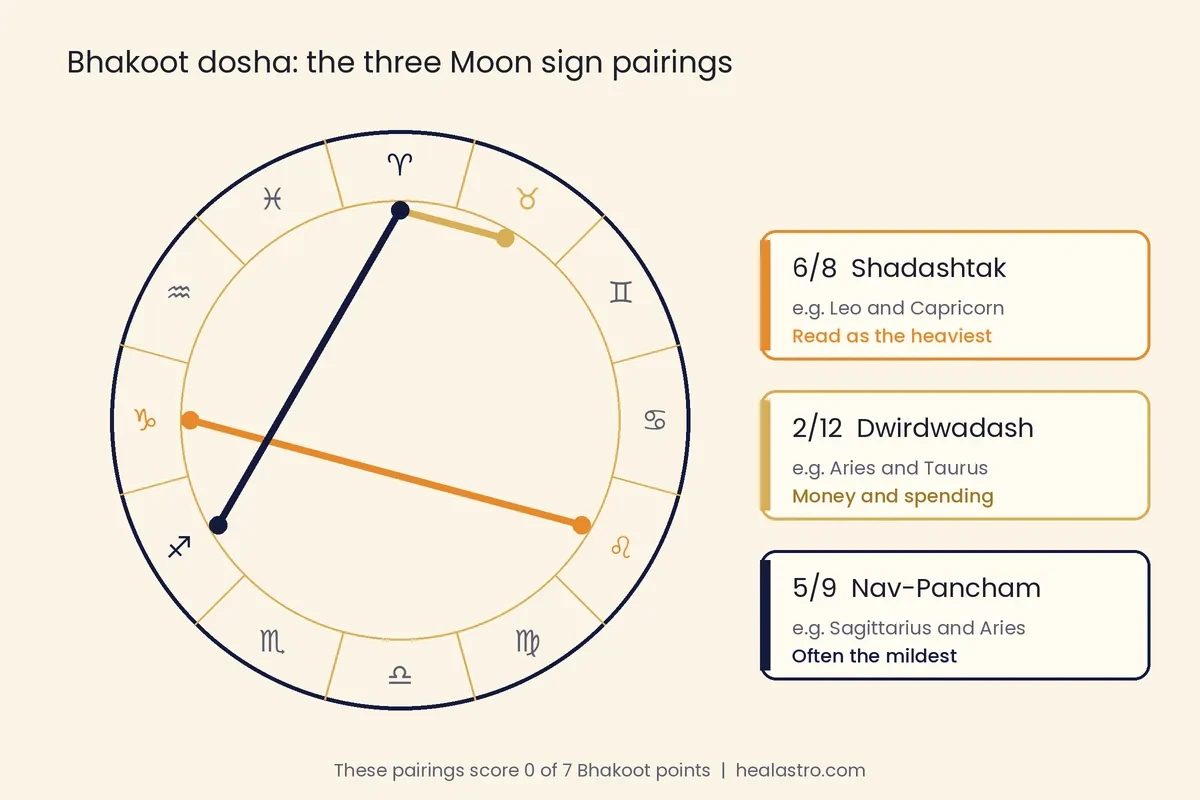
Many websites list 5/9 as plain dosha. We disagree. Several traditions treat Nav-Pancham as favourable in one direction and weaker in the reverse, which is why we ask which partner's sign is fifth and which is ninth before saying anything.
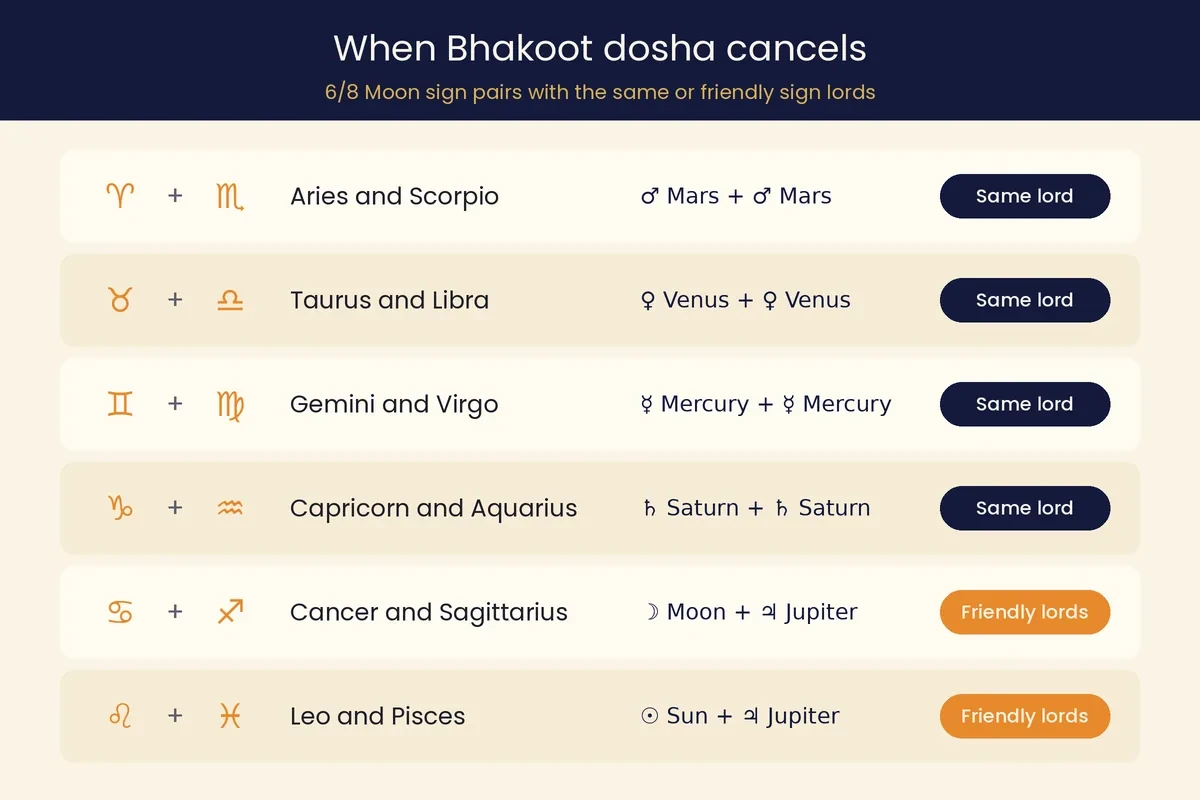
Bhakoot dosha is generally considered cancelled when the lords of the two Moon signs are the same planet or are natural friends. This is the commonest rule in matching texts, and it knocks out a large share of the 6/8 cases people worry about.
The classic 6/8 pairs that stay unharmed are:
| Sign pair | Sign lords | Why it cancels |
|---|---|---|
| Aries and Scorpio | Mars and Mars | Same lord |
| Taurus and Libra | Venus and Venus | Same lord |
| Gemini and Virgo | Mercury and Mercury | Same lord |
| Capricorn and Aquarius | Saturn and Saturn | Same lord |
| Cancer and Sagittarius | Moon and Jupiter | Friendly lords |
| Leo and Pisces | Sun and Jupiter | Friendly lords |
For 2/12 and 5/9, the same idea applies: friendly or identical lords soften the flag. Our astrologers also look at three further things before deciding:
Note the word "generally". Cancellation rules vary between schools, and an honest astrologer will tell you which rule they are applying.
You can do a first pass in five minutes. It will not replace a chart reading, but it tells you whether there is anything to ask about.
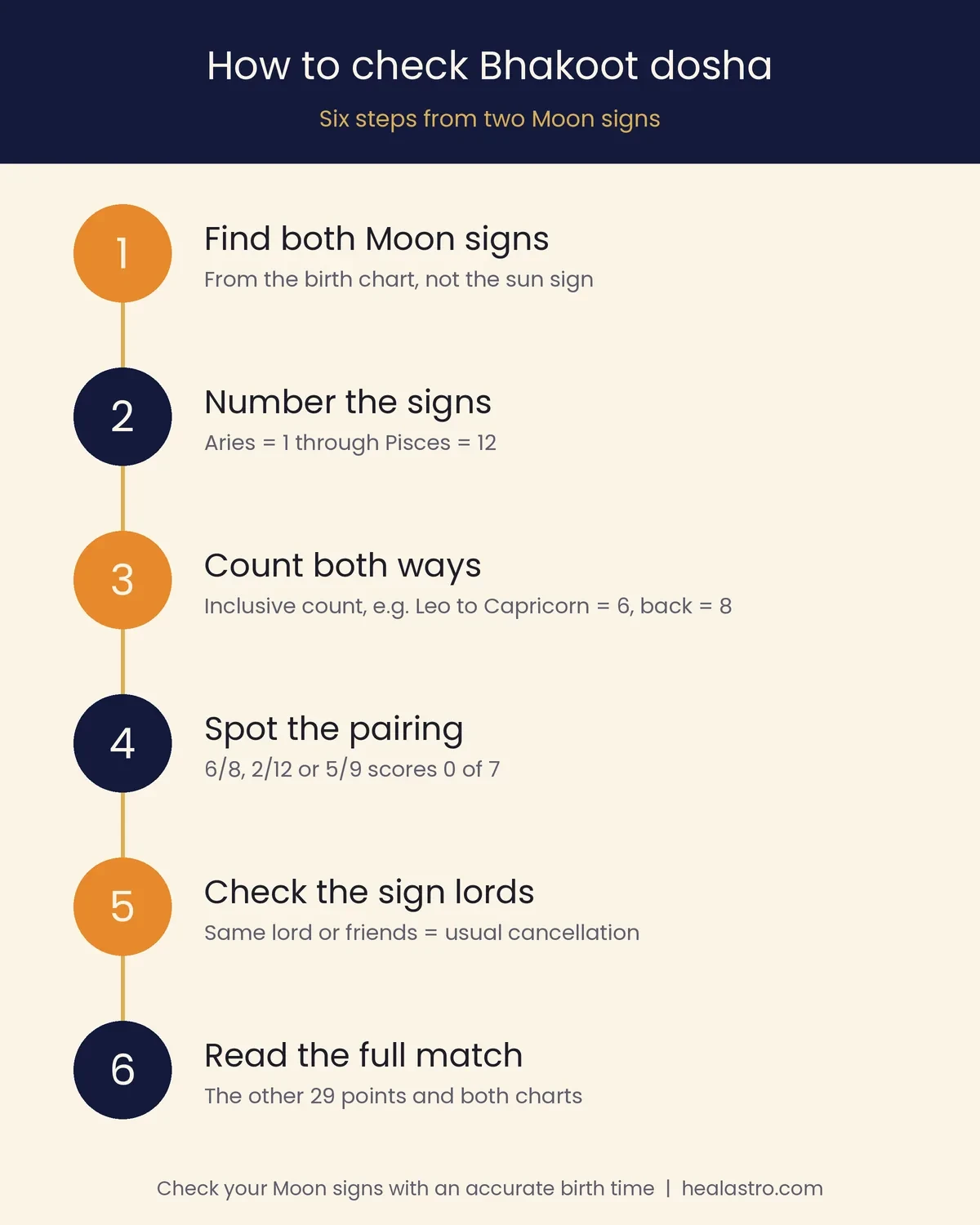
Not sure which planet rules which sign? Mars rules Aries and Scorpio, Venus rules Taurus and Libra, Mercury rules Gemini and Virgo, the Moon rules Cancer, the Sun rules Leo, Jupiter rules Sagittarius and Pisces, and Saturn rules Capricorn and Aquarius.
An honest limitation: everything above rests on an accurate Moon sign. The Moon changes sign roughly every two and a quarter days, so if the birth time is wrong by a few hours near a sign boundary, the whole Bhakoot result can flip. If the time is uncertain, say so before any matching is done.
This is a constructed example, not a real client.
Rohan has his Moon in Leo. Neha has her Moon in Capricorn. Counting from Leo to Capricorn gives six, and from Capricorn to Leo gives eight, so this is a Shadashtak pairing. The lords are the Sun and Saturn, which are not friends in classical terms. Bhakoot scores zero and the dosha is not cancelled by the usual rule.
What would our astrologers do next? They would not stop at the zero. They would see whether Nadi and Gana are clean, where each Moon sits by house and nakshatra, and how the 7th house and Venus stand in both charts. If those were steady, they would likely tell the families that the match deserves a proper conversation and that watching money habits and communication in the early years is sensible. If the 7th houses were also under strain, they would say so plainly.
A zero on one koota, then, is a prompt for more questions. It is rarely a verdict.
| Myth | Fact |
|---|---|
| Bhakoot dosha means the marriage will fail | It flags areas to examine; many couples with the flag, and with cancellation, do well |
| A low total score means rejection | The 18-point rule of thumb is a convention, not a law; the weak koota and the chart matter more |
| Only the girl's side is affected | The rule is about the relationship between two Moon signs, so it concerns both |
| A puja fixes the dosha | Pujas are traditional acts of faith; they cannot guarantee an outcome |
| Online tools are always right | A tool is only as good as the birth time you enter; check it with an astrologer |
Remedies for bhakoot dosha are traditional practices meant to bring steadiness to the Moon and calm to the relationship, and they work as acts of faith, not as guarantees. We always tell families to treat them as support alongside honest conversation, not as a substitute.
Practices our astrologers most often suggest for a flagged Bhakoot:
Practical remedies matter too. If the flag points to money friction (2/12), agree on a shared budget early. If it points to friction (6/8), decide how you will handle disagreements with elders. These are not in any scripture, but we have found they help.
Bhakoot is one item on the guna sheet, and families often find it alongside other flags. Our guide to planetary doshas explains how to weigh several flags at once. If Mars is involved, read our Manglik dosha article too.
Our view is simple. One cancelled dosha is common and usually manageable. Three uncancelled doshas in the same sheet deserve a longer conversation with an astrologer, and probably with the families.
If you also want a timing view of the future marriage, the marriage prediction by date of birth article shows how dashas point to likely periods.
Online consultation works just as well as an in-person visit, because the kundli is a set of calculations and not a physical object. Families from Delhi NCR, Mumbai, Jaipur, Lucknow, Kolkata, Bengaluru and Pune speak to our astrologers by phone or chat every week, often with parents on one call and the boy or girl on another.
What you need is simple: both birth dates, accurate birth times and places, and the guna sheet if a pandit has already prepared one. If your family is in another city or abroad, the process is the same.
Talk to a HealAstro astrologer about your bhakoot dosha
It is a zero score in the Bhakoot koota, caused by Moon signs that are 6/8, 2/12 or 5/9 apart. Bhakoot carries 7 of 36 points. Traditionally it points to money, family comfort and understanding between partners, and it is a flag for closer reading, not a final verdict on the match.
It can be, but it is rarely the final word. The 6/8 pairing is usually taken most seriously and 5/9 most lightly. The answer depends on cancellation, the Nadi koota, the Moon's placement and the 7th houses of both charts, which is why a full reading matters more than the score.
Yes, in many cases. The usual rule is that it cancels when the two Moon signs share a lord or their lords are friends, such as Aries and Scorpio (both ruled by Mars). Some schools add further conditions, so ask which rule your astrologer is applying.
The full 7 points. That happens when the Moon signs are in the same sign, opposite each other (1/7), or 3/11 or 4/10 apart. Together with the other seven kootas, the total out of 36 gives the familiar guna score families talk about.
No, not on this one flag alone. We suggest looking at cancellation first, then the rest of the guna sheet, then the charts. Many families go ahead after a proper reading, and some decide against it for other reasons. The decision is yours, not the chart's.
Traditional options include Monday fasting, Shiva worship, Chandra mantras and a Gauri-Shankar puja. They are acts of faith and cannot guarantee any result. We also suggest agreeing on money and family boundaries early, since those are the areas the dosha traditionally points to.
It can. The Moon moves into a new sign about every two and a quarter days, so a time that is off by a few hours near a boundary may change the Moon sign and the whole Bhakoot result. If the birth time is uncertain, tell the astrologer before the match is read.
A Bhakoot zero is worth understanding, and it is rarely worth panicking over. Check the pairing, check for cancellation, and then look at the rest of the sheet and both charts before anyone makes a call. If you would like our astrologers to read the sheet with you, start with the free matching tool above and then book a consultation.
For a written, chart-based comparison, the Match Making Kundali Report covers all eight kootas, the doshas and cancellations for both people. And if you prefer to keep things on your phone, the HealAstro Android app puts kundli tools in your pocket.
Disclaimer: Astrology offers guidance based on traditional Vedic principles. It is not a substitute for medical, legal, financial or psychological advice, and no astrologer can guarantee an outcome.