
Key points at a glance
A mother in Lucknow shows us her son's kundli (birth chart), made with our free tool, and points at the seventh box. "Shani is sitting here. Does that mean his marriage will be bad?" It is the most common question we hear, and the answer is almost always "not by itself." To answer it properly, you need to know what the 12 houses in Vedic astrology actually represent and how they work together. A single planet in a single house tells you very little. The house lord, the sign, aspects and the running dasha change the picture completely. This guide walks through every house in plain language, shows you how our astrologers read them, and clears up a few myths that cause needless worry. Keep your own chart open as you read.
Get your houses read by an expert: talk to a HealAstro astrologer now
The 12 houses in Vedic astrology are twelve divisions of the birth chart, each called a bhava, that map different parts of life. The first house starts from your ascendant at birth. Each later house covers one sign in order, and together they describe personality, money, siblings, home, children, health, marriage, longevity, luck, career, gains and losses.
Think of the zodiac signs as the costume and the planets as the actors. The houses are the stage: they tell you where in your life a planet's results will show up.
Your lagna (ascendant) is the sign rising on the eastern horizon at the moment of birth, and it fixes the first house. Every other house follows from it.
The ascendant changes roughly every two hours. Two babies born in the same Delhi hospital on the same morning can have completely different house layouts if they were born three hours apart. That is why our astrologers ask for the time from the birth certificate or hospital record rather than "around morning."
Most North Indian astrologers use whole-sign houses: the full sign of the lagna is the first house, the next sign is the second, and so on. Some also check the bhava chalit chart, which shifts planets near a house cusp into the neighbouring house. We look at both when a planet sits close to the edge of a sign.
In the North Indian diamond chart, the houses stay fixed and the sign numbers move. The top central diamond is always the first house. In the South Indian square chart, the signs stay fixed and the lagna is marked with a line. The 12 houses in Vedic astrology mean the same thing in both formats. Only the drawing differs.
Each bhava has a Sanskrit name, a set of life areas and a natural significator, or karaka. The table below is a quick reference you can keep open while reading your own chart.
| House | Sanskrit name | Main life areas | Natural karaka |
|---|---|---|---|
| 1st | Tanu bhava | Body, personality, health, overall direction | Sun |
| 2nd | Dhana bhava | Family wealth, speech, food habits, early education | Jupiter |
| 3rd | Sahaja bhava | Younger siblings, courage, short travel, communication | Mars |
| 4th | Sukha / Bandhu bhava | Mother, home, property, vehicles, inner peace | Moon |
| 5th | Putra bhava | Children, intelligence, romance, past-life merit | Jupiter |
| 6th | Ari / Shatru bhava | Debts, disease, enemies, competition, daily work | Mars, Saturn |
| 7th | Kalatra bhava | Spouse, marriage, partnerships, public dealings | Venus |
| 8th | Ayu / Randhra bhava | Longevity, sudden events, inheritance, research, the occult | Saturn |
| 9th | Dharma / Bhagya bhava | Father, guru, luck, higher learning, long pilgrimages | Jupiter, Sun |
| 10th | Karma bhava | Career, status, authority, public reputation | Sun, Mercury, Jupiter, Saturn |
| 11th | Labha bhava | Income, gains, elder siblings, friends, fulfilled wishes | Jupiter |
| 12th | Vyaya bhava | Expenses, foreign lands, sleep, isolation, moksha | Saturn |
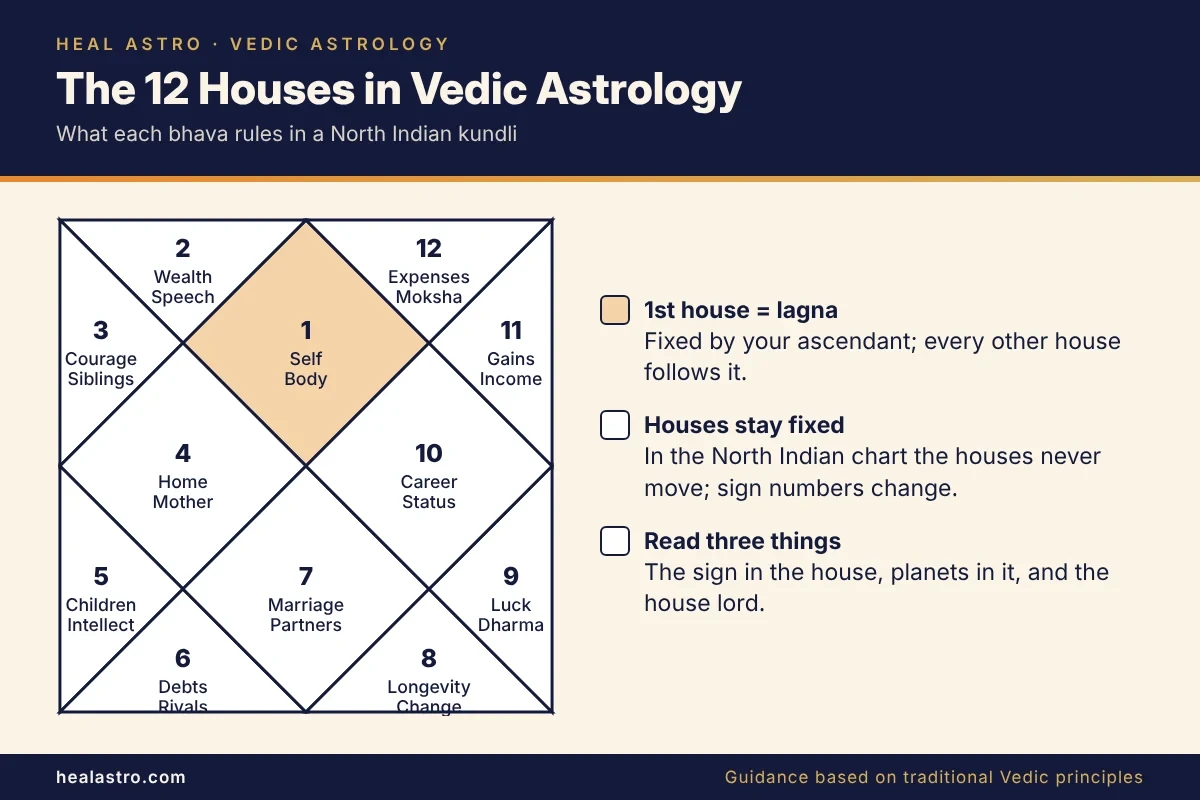
The first house is you: your body, temperament and the general direction of life. A strong lagna lord can carry a chart that looks weak elsewhere.
The second house covers money you hold, family values and speech. A harsh planet here often shows up as blunt speech before it shows up in the bank account.
The third house is effort. Courage, younger siblings, writing, short trips and skills you build with your own hands all sit here. Malefics like Mars and Saturn often do well in this house because they give drive.
The fourth house is mother, home, land and peace of mind. When families ask about buying a flat, our astrologers look here first, along with the fourth lord's dasha.
The fifth house rules children, intelligence, creativity and romance. It is also called the house of purva punya, merit carried from past lives. It is one of the two houses we check for students preparing for competitive exams.
The sixth house handles debts, illness, rivals and service. Strong placements here help lawyers, doctors and anyone in a competitive job. It is a dusthana, but it is also an upachaya, so results improve with age.
The seventh house is marriage and partnerships of every kind, including business. Our guide to marriage prediction by date of birth shows how this house combines with Venus and the Navamsa chart.
The eighth house is the most misunderstood. Yes, it covers longevity and sudden events. It also covers inheritance, insurance, research, in-laws' money and deep spiritual study. Many astrologers and researchers have a strong eighth house.
The ninth house is dharma: father, teachers, faith, higher education and long-distance pilgrimage. A healthy ninth lord is often called the "bhagya" factor.
The tenth house is karma, meaning action in the world. Job, promotion, authority and reputation live here. Government job questions also involve the Sun and the sixth house.
The eleventh house is gains. Salary hikes, network, elder siblings and wishes coming true all show up here. Almost every planet gives some good result in the eleventh.
The twelfth house covers expenses, sleep, hospitals, ashrams and foreign residence. For many families sending a child abroad, a well-placed twelfth house with a link to the ninth or fourth is a positive sign. It is also the house of moksha.
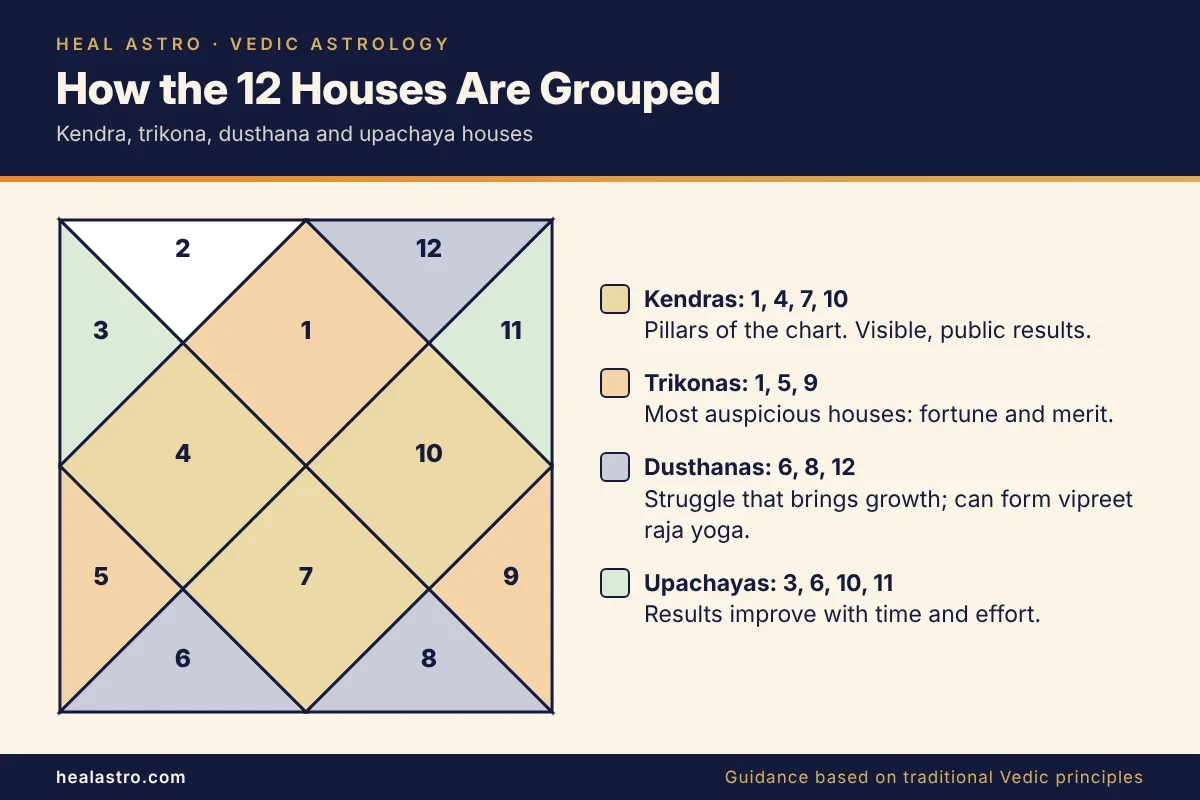
Classical texts sort the bhavas into groups that tell you how strong or difficult a house tends to be. Learning these groups saves a lot of guesswork.
Kendras (angular houses): 1, 4, 7, 10. These are the pillars of the chart. Planets here have visible, public results. Brihat Parashara Hora Shastra gives special weight to kendra lords.
Trikonas (trines): 1, 5, 9. These are the most auspicious houses, linked to fortune and merit. When a kendra lord and a trikona lord join, it forms a raja yoga.
Dusthanas (difficult houses): 6, 8, 12. These bring struggle, but also growth. A dusthana lord placed in another dusthana can form a vipreet raja yoga, which turns obstacles into gains.
Upachayas (growth houses): 3, 6, 10, 11. Results here improve with time and effort. Natural malefics often do better here than benefics.
The four aims of life (purusharthas):
Want the full picture? Order a Complete Kundli Report with house-by-house analysis
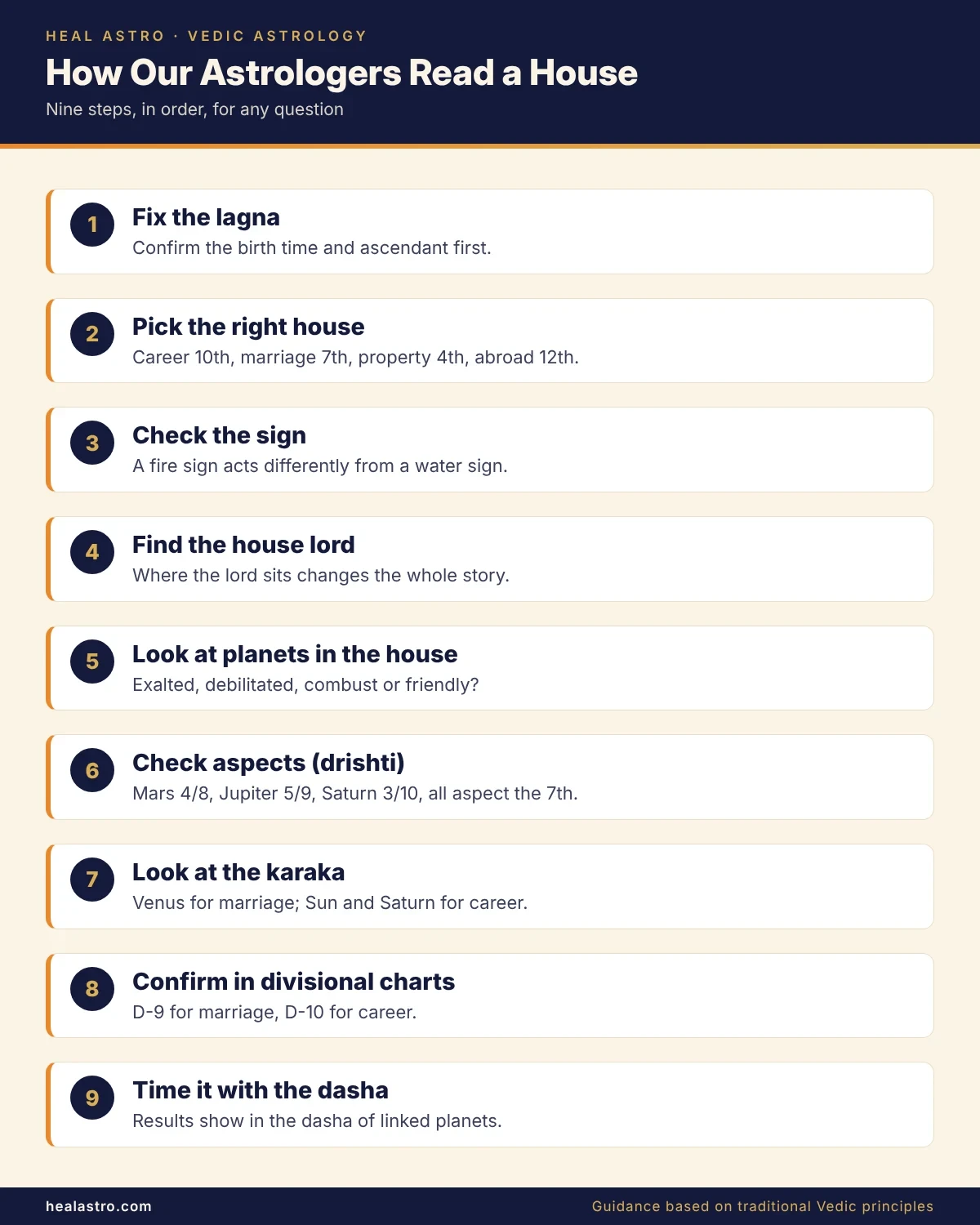
Reading a house well takes more than spotting which planet sits in it. Here is the order our astrologers follow for any question.
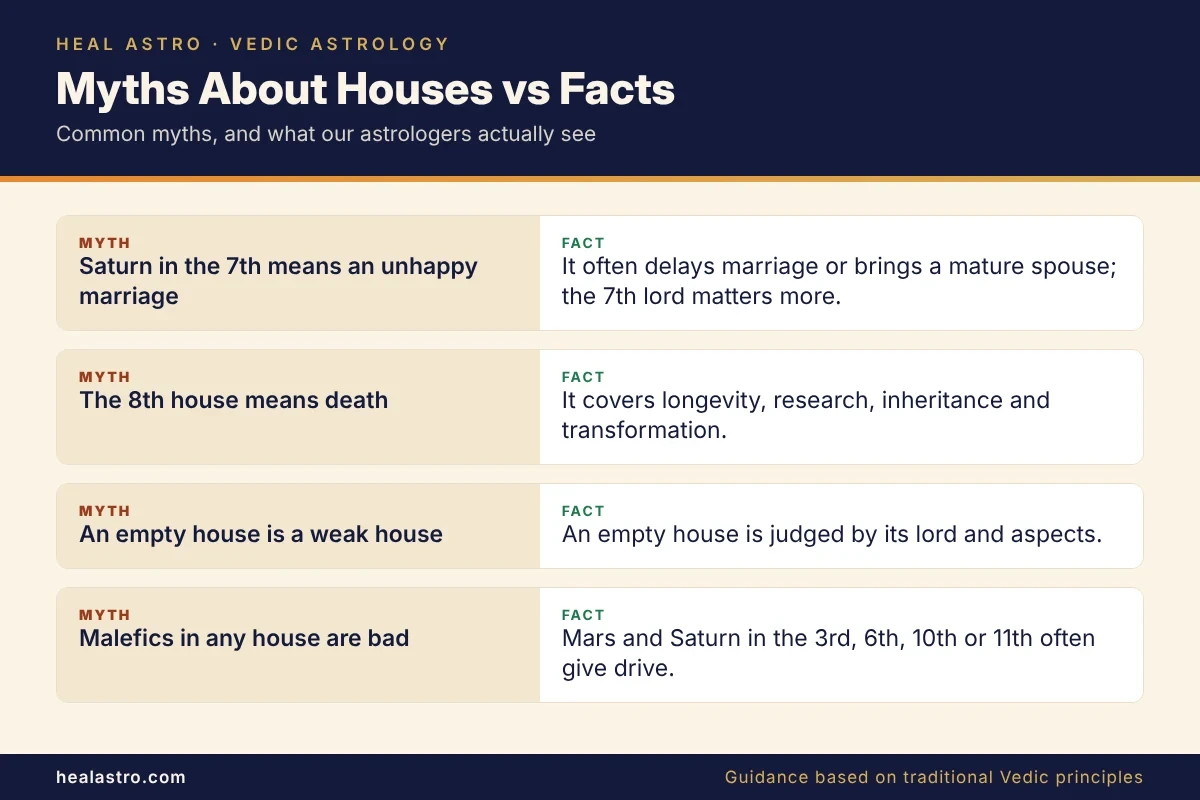
Most fear around houses comes from reading one placement in isolation. Here are the myths we hear most often in consultations.
| Myth | Fact |
|---|---|
| Saturn in the 7th house means an unhappy marriage | Saturn here often delays marriage or brings an older or more serious spouse. The sign, aspects and seventh lord matter far more. |
| The 8th house means death | The eighth house covers longevity, research, inheritance and transformation. A planet here rarely means anything frightening on its own. |
| An empty house is a weak house | An empty house is judged by its lord. Many successful careers come from an empty tenth house with a strong tenth lord. |
| The 12th house only brings losses | The twelfth also governs foreign travel, spiritual growth, sleep and charity. Expenses can be on good things. |
| Malefics in any house are bad | Mars and Saturn in the 3rd, 6th, 10th or 11th often give drive, discipline and success. |
| Planets give results all the time | A placement mainly shows results during its dasha or a strong transit. |
Many websites list "results of Mars in each house" as if those lines were final verdicts. We disagree with that approach. A single-line reading ignores the house lord, aspects and dasha, which are what actually decide the outcome.
This is an illustrative example, not a real client.
Consider a 29-year-old in Pune with Gemini lagna who keeps switching jobs and asks whether her career will settle. Her tenth house is Pisces and is empty. Jupiter, the tenth lord, sits in the fifth house in Libra, aspected by Saturn.
Reading only the empty tenth house, someone might say "weak career." Our approach looks further. Jupiter in the fifth links career to intelligence, teaching and advisory work. Saturn's aspect adds delay and pressure but also staying power. In her Dashamsa chart, Jupiter is better placed.
She is running Rahu mahadasha, and Rahu sits in the twelfth, which fits the restlessness and frequent changes. The more settled phase would be expected when Jupiter's dasha begins, which supports a stable advisory or training role. Our advice in a case like this would be practical: pick one field that uses analysis and communication, build credentials, and use the remaining Rahu years to gain varied experience instead of fighting it.
A house reading is only as accurate as the birth time behind it. If your time is off by even 15 to 20 minutes near a sign change, the lagna and every house can shift by one. That changes the reading entirely.
Houses also describe tendencies, not fixed events. Free will, effort, family situation and timing all shape how a placement plays out. We would rather tell you "the chart shows struggle in property matters during this dasha" than promise you a flat by March.
If you do not know your birth time, a Moon-sign (Chandra lagna) chart still gives useful broad guidance. It just cannot be as precise.
Remedies in Vedic astrology are traditional practices and acts of faith. They can support patience and focus, but no remedy can guarantee an outcome. Our astrologers usually suggest the simplest steps first.
Book a one-to-one Grah Dosh puja for a troubled house lord
Families in Delhi NCR, Mumbai, Jaipur, Bengaluru, Kolkata, Hyderabad and Ahmedabad often ask whether they need to meet an astrologer in person. You don't. A house-by-house reading only needs your date, time and place of birth, and our astrologers work from the same chart whether you call from Chandni Chowk or from Whitefield.
Online consultation also lets you share the chart with family members in another city and ask follow-up questions on the same call. Many of our consultations are three-way calls between parents in one city and a son or daughter in another. If you prefer typing, you can chat with an astrologer instead of calling.
The first house, or lagna, is the most important. It represents your body, personality and overall direction, and it fixes the order of every other house. A strong lagna lord can support the whole chart even when other houses look weak. After the lagna, the kendras and trikonas carry the most weight.
The tenth house is the main career house. Our astrologers also check the sixth house for service and competition, the second for earnings and the eleventh for gains. The tenth lord's placement, planets aspecting the tenth, and the Dashamsa (D-10) chart together show the type of work and when progress is likely.
The seventh house shows marriage and the spouse. Its sign, lord and any planets in it describe the partner and the nature of the relationship. Venus is the karaka for marriage, and the Navamsa chart confirms what the seventh house promises. Timing comes from the dasha of planets linked to the seventh.
No, the 8th house is not always bad. It rules longevity, sudden changes, inheritance, research and spiritual depth. Difficult planets here can bring upheaval, but well-placed ones can give insurance gains, in-law support or a talent for investigation. It is judged with its lord and the running dasha, never alone.
An empty house simply has no planet in it, which is normal since nine planets cannot fill twelve houses. Our astrologers read an empty house through its sign, its lord's placement and any aspects it receives. An empty seventh or tenth house does not mean no marriage or no career.
You can get a broad reading without a birth time, but not a precise one. Without it, astrologers use your Moon sign as the first house (Chandra lagna). This shows general trends, especially for transits like Sade Sati. For house-specific questions about career, marriage or property, an accurate time makes a large difference.
Vedic astrology uses the sidereal zodiac and usually whole-sign houses, while most Western astrologers use the tropical zodiac and systems like Placidus. Because of the ayanamsa difference of roughly 24 degrees, many planets shift back by one sign. The meanings of the houses are broadly similar, but timing tools like dashas are unique to Vedic astrology.
The 12 houses in Vedic astrology give a map of your life, but a map is only useful when someone reads all of it together. A single placement can look frightening. The full chart, with its lords, aspects and dashas, almost always tells a more balanced story.
If you want a clear answer about a specific house, speak with one of our astrologers. They will check your lagna, explain what your houses show and tell you honestly what they cannot predict.
Talk to a HealAstro astrologer about your houses
Prefer something in writing? The Complete Kundli Report covers all twelve bhavas, or you can get daily guidance on the HealAstro Android app.
Disclaimer: Astrology offers guidance based on traditional Vedic principles. It is not a substitute for medical, legal, financial or psychological advice, and no astrologer can guarantee an outcome.