Key points at a glance
The rishta looks good, and the girl's mother has already asked for the kundli. Then the other side says the birth time was never written down. Only a name and a date remain. Families in this spot ask whether kundali matching for marriage can be done by name alone, and the honest answer is: partly, and with limits. This guide explains what a name can tell you, what it cannot, and how to get a reliable match when the birth time is lost.
Try our free Kundali Matching tool with whatever birth details you have
Kundli matching by name is a traditional shortcut that estimates each partner's Moon sign (rashi) from the first syllable of their name, then runs the Ashtakoot (eight-factor) Guna Milan on those estimated signs. It gives a rough compatibility guess when birth details are missing. It is less reliable than a match built on the birth chart.
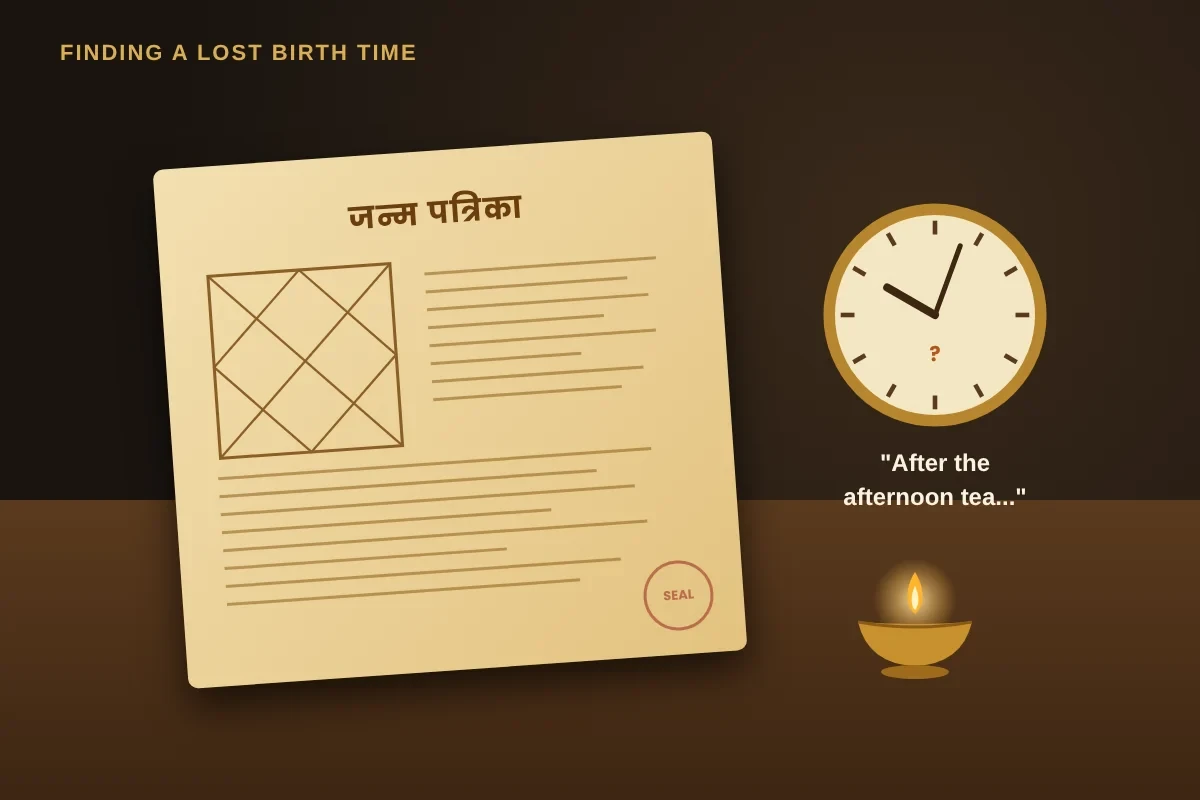
Most Indian families did not write birth times down until recent decades. In many homes the only record is a pandit's handwritten patri, and it often goes missing after a house move or a family partition. Sometimes the birth was in a village hospital and the time noted was "morning".
So the question arrives on WhatsApp at 11 pm: "We have only the name and date of birth, can you match?"
Name-based matching exists because Vedic astrology has always worked in layers. When the full chart is unavailable, an astrologer falls back to the Moon, because Guna Milan reads the Moon sign and nakshatra (lunar mansion) and little else. A name is one of the few clues left that points to the Moon.
We should be clear about where we stand. Many sites sell name-based matching as if it were as good as a chart. We disagree. It is a screening step, and treating it as a verdict can cost a family a good rishta or, worse, approve a poor one.
A name points to a Moon sign only if it was chosen the traditional way, from the naam akshar (starting syllable) assigned to the nakshatra pada (quarter) the Moon occupied at birth. Each of the 27 nakshatras has four padas, so there are 108 padas, and each has its own syllable. A child born with the Moon in Ashwini pada 1 would traditionally be called a name starting with "Chu", for example.
Here is how an astrologer uses it:
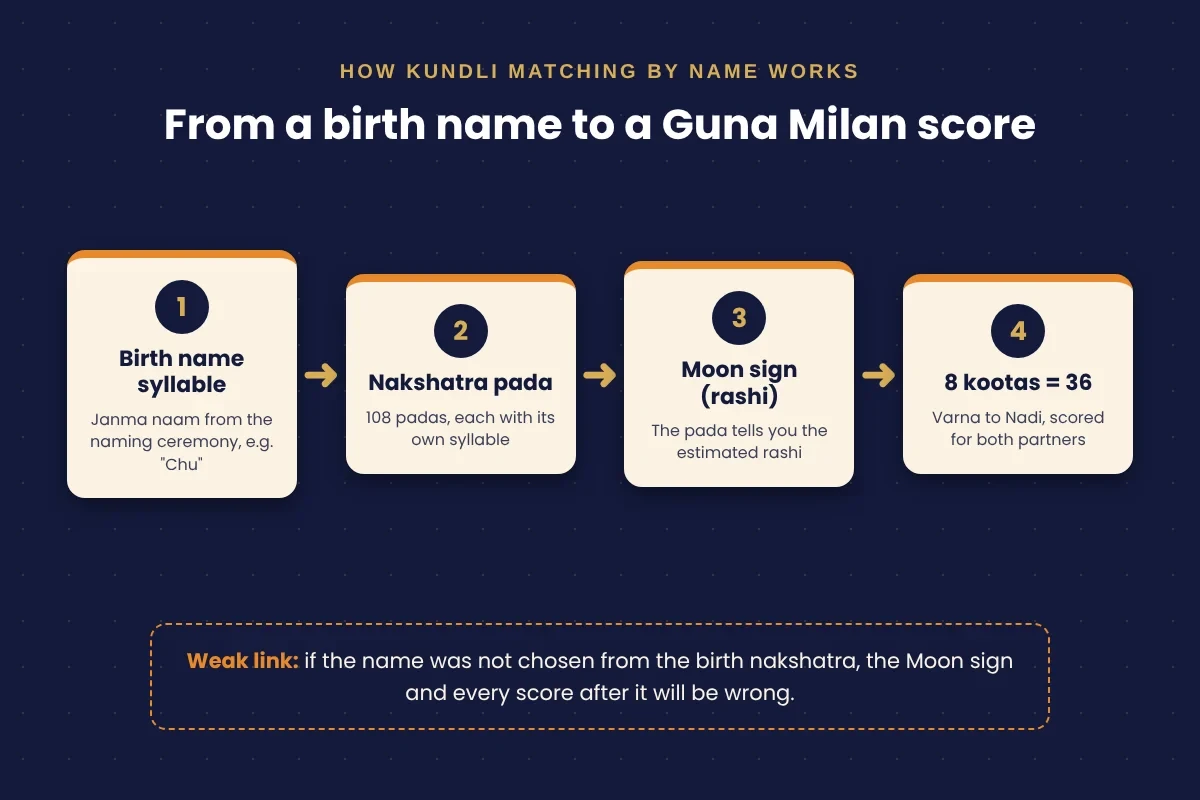
The weak link is step 1. Plenty of people carry a name that was picked for sound, family tradition or a numerology tip, not the birth nakshatra. For them, the syllable method gives a wrong Moon sign, and every score after it is wrong too.
A person called "Rahul" at home and "Rohit" in school certificates can land on two different Moon signs. A name-based match is only as good as the name used. That is why we ask for the name given at the naming ceremony (namkaran), and why we say plainly when the family cannot confirm it.
A name can stand in for the Moon, but it cannot stand in for the birth time. This table shows which parts of a match survive without the time.
| Check | Birth time needed? | Can a name replace it? |
|---|---|---|
| Moon sign (rashi) | Sometimes. The Moon changes sign roughly every 2.3 days, so a date can be enough on most days | Only roughly |
| Nakshatra and pada | Often. The Moon spends about a day in each nakshatra and about 6 hours in each pada | Only roughly |
| Guna Milan (36 points) | No, if the Moon sign and nakshatra are known | Partly |
| Nadi and Bhakoot dosha | No, same inputs as Guna Milan | Partly |
| Lagna (ascendant) | Yes, it changes about every two hours | No |
| Mangal dosha from Lagna | Yes | No |
| 7th house and its lord | Yes | No |
| Navamsa (D9) chart | Yes, to be dependable | No |
| Dasha sequence and balance | Yes, the exact Moon degree sets it | No |
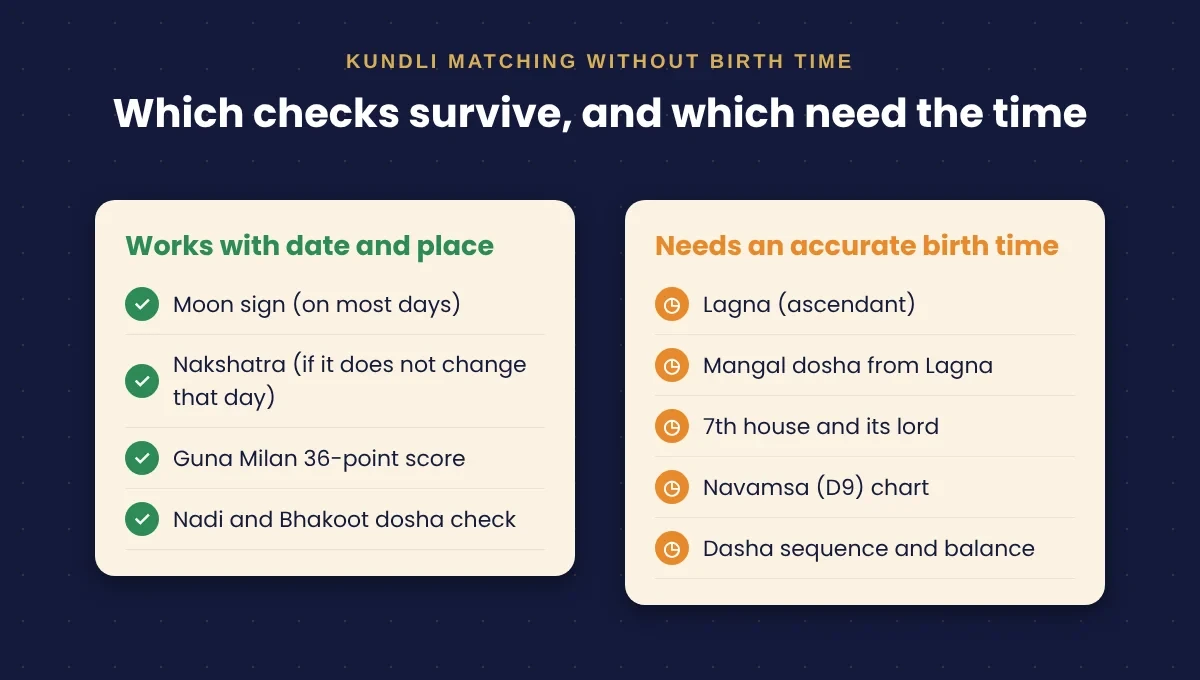
Read the table once more. The score survives, but most of the depth of a kundli milan does not. If you want the full picture of why timing matters for the 7th house, our guide on marriage prediction by date of birth shows how much of the reading depends on the Lagna.
| Myth | Fact |
|---|---|
| A name alone gives the same match as a full kundli | A name gives an estimated Moon sign. It cannot give the Lagna, the 7th house or the Mangal dosha status |
| A high score by name means the marriage is safe | The total is only one input. Classical texts such as Brihat Parashara Hora Shastra expect the whole chart to be read |
| Any name works, including a nickname | Only the janma naam chosen from the birth nakshatra syllable carries the signal |
| A low score by name means you must reject the rishta | A low estimate is a reason to get the real birth details checked, not a reason to walk away |
| Online tools can fix a missing birth time | A tool can guess, and so can we. Birth time rectification is an astrologer's judgement, not a certainty |
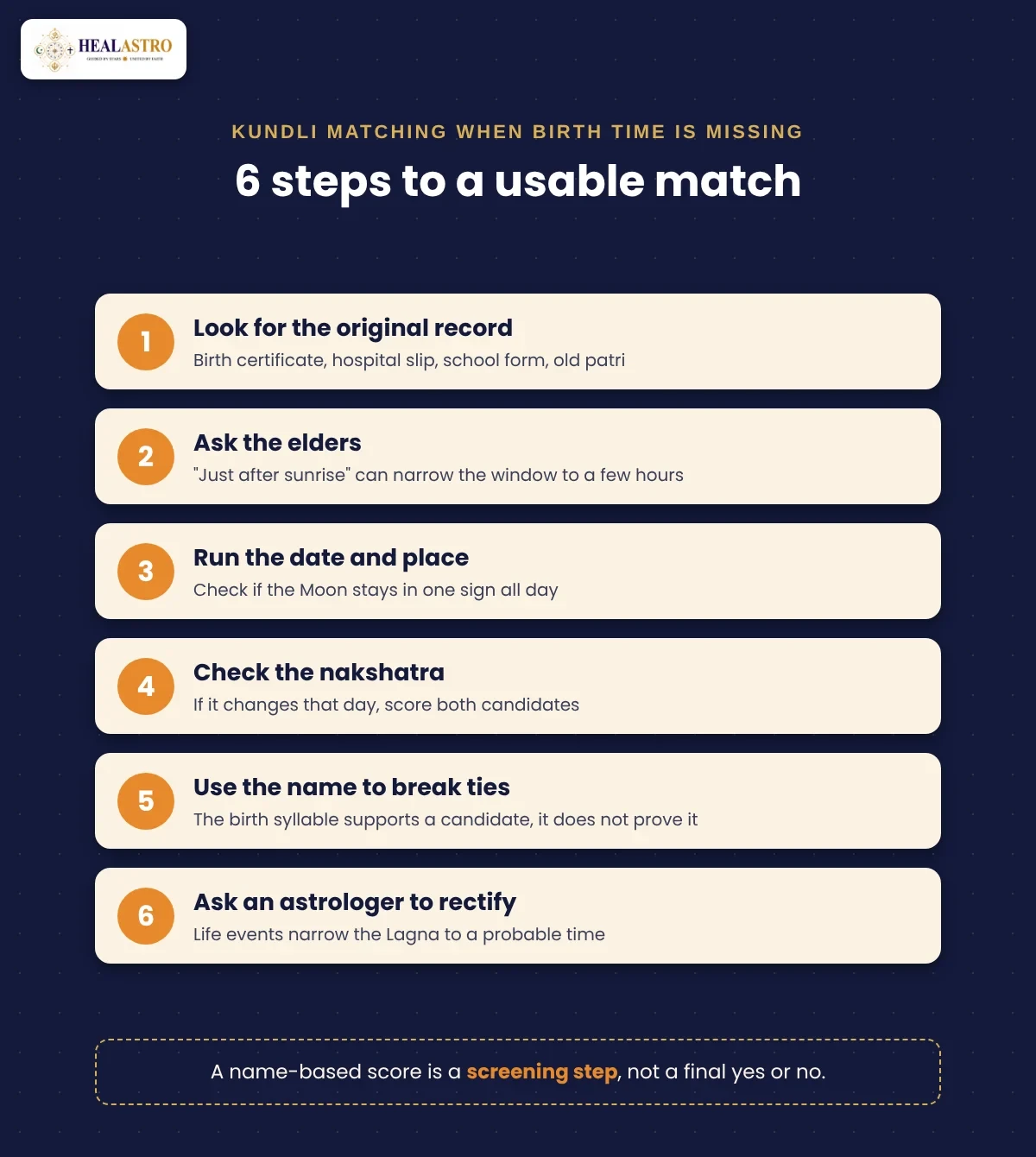
You have more options than "name or nothing". Work through them in this order.
If step 3 shows the Moon moved from one sign to the next during that day, we tell the family the match cannot be called safe yet. That is our position, and we hold it even when a family is in a hurry before roka.
This is an illustrative case, not a real client.
A family in Lucknow has a boy's date of birth from his school record but no birth time. The girl's family from Jaipur has a full kundli, and her Moon sign is Aquarius. The Moon on the boy's birth date moved from Cancer to Leo around the afternoon, so the Moon sign is either Cancer or Leo depending on the hour.
Scoring both gives two results. With Cancer, the Bhakoot koota between Cancer and Aquarius is a 6/8 pairing (shadashtak), traditionally marked as a dosha. With Leo and Aquarius, the signs sit opposite each other and Bhakoot scores its full 7 points. That one factor alone moves the total by 7 points, and the second option clears the usual 18-point minimum comfortably while the first needs a cancellation check.
The family had been about to decide on a name-based guess. We asked instead for the mother's memory of the day. She recalled that the boy was born "after the afternoon tea". That narrowed the window to the later part of the day, which supported Leo. We still told them the Lagna was unconfirmed and that Mangal dosha could not be read until the time was fixed.
Two points from the case. A date and place can settle a lot. And the honest answer to "is it a match" was "likely, pending the time", which is less satisfying and more useful.
The practical step is to keep the rishta talks open and fix the data, not to rush or to reject. Traditional practices can sit alongside this as acts of faith, with no promise of any outcome.
Some families offer water to Lord Shiva on Mondays or recite the Mahamrityunjay mantra for the couple's wellbeing. Others visit their kuldevta (family deity) before the final decision. These are customs of devotion, and we describe them as that. They do not replace checking the chart.
Gemstones should not be bought for a relationship concern on a guess. We suggest a stone only after a chart check, and a chart check needs the birth time. If delay itself is the worry, our article on late marriage in kundli explains the planetary patterns that matter and what is reasonable to do about them.
Talk to a Vedic astrologer about your birth details
Online kundli matching works just as well as sitting across a table from an astrologer, because the calculation depends on the chart, not on where you are. We hear from readers in Delhi NCR, Mumbai, Jaipur, Lucknow, Bengaluru, Hyderabad and Pune, and the questions are similar. Someone has a date but no time. Someone's grandmother remembers the hour only loosely.
A video or phone call lets our astrologers ask about the family's memories, which is how birth time rectification actually starts. You can share the details of both partners on a call, and we explain the result in Hindi or English. There is no need to travel to a pandit in another city for this.
Only roughly. A name can suggest a Moon sign if it was chosen from the birth nakshatra syllable, and that allows an estimated Guna Milan score. It cannot show the Lagna, the 7th house or Mangal dosha. Treat a score from kundli matching by name as a screening step and confirm it with birth details.
Yes, for Guna Milan in many cases. The Moon sign and nakshatra often stay the same through the day, so the date and place can be enough. If the Moon changes sign that day, the result is uncertain. Lagna-based checks such as Mangal dosha and the 7th house need the time.
The birth name given at the naming ceremony is used, because it follows the nakshatra syllable. A nickname, a school-record spelling or a name changed for numerology does not carry the same signal. If the family cannot confirm the janma naam, a name-based match is unreliable.
Eighteen out of 36 is the traditional minimum. Nadi carries 8 points and Bhakoot 7, so a dosha in either one lowers the score sharply. Even a score above 18 does not settle things, since an astrologer still reads the Mangal status, the 7th house and the dashas.
Often, yes, within a window. Start with the birth certificate, hospital slip and school record. If nothing exists, an astrologer can narrow the time using major life events. The result is a probable time, not a certain one, and we label it that way.
Many families use it as a first filter, but most pandits want the full kundli before the roka or engagement. We advise using a name-based score to decide whether a rishta is worth pursuing, then confirming with the real details. No score can guarantee a happy marriage.
Do not reject the rishta on that alone. A low estimated score often reflects a wrong Moon sign guess. Get the birth date and place checked first, then recalculate. If the score stays low with confirmed details, an astrologer can check whether a cancellation rule applies.
If the birth time is lost, begin with what you do have. Use kundli matching by name only to decide whether the rishta deserves a closer look, then fix the data. Our Match Making Kundali Report covers Ashtakoot, Dashakoot, Manglik status and Nadi and Bhakoot checks from the details you give us, and our astrologers will tell you which parts of the result you can trust. Keep the rishta talks going while you do.
You can also keep your charts and consultations in one place with the HealAstro Android app.
Disclaimer: Astrology offers guidance based on traditional Vedic principles. It is not a substitute for medical, legal, financial or psychological advice, and no astrologer can guarantee an outcome.