Key points at a glance
The first rishta meeting went well. Both families liked each other, the boy and girl spoke for an hour, and then someone's aunt asked the question that changes the mood in the room: "Kundli milaayi kya?" (Have the kundlis been matched?) A day later a free website says 16 out of 36, and everyone goes quiet. We see this pattern constantly. Kundli milan is a serious tradition with real reasoning behind it, but a single number has started doing a job it was never meant to do alone. In this guide our astrologers explain what each of the 36 gunas measures, which doshas matter, what the score leaves out, and how to read a match properly. If you have both sets of birth details ready, you can run a free kundali matching check while you read.
Got a low score or a dosha? Get your match reviewed by a HealAstro astrologer
Kundali matching is the Vedic practice of comparing a bride's and groom's birth charts to assess marriage compatibility. The best-known method, Ashtakoot Guna Milan, scores eight factors based on both partners' Moon signs and nakshatras, for a total of 36 points. Astrologers then check doshas, the 7th house and planetary periods for a complete view.
In Hindi it is called kundli milan or gun milan. In South India, a ten-factor method called Dashakoot or Porutham is more common.
For many Indian families, kundali matching is not superstition. It is due diligence, the astrological equivalent of meeting the family and checking the background.
It helps in three practical ways. It gives both families a shared, neutral reference point. It flags areas where the couple may need more patience, such as temperament or health. And when the reading is done well, it reassures elders, which takes real pressure off the couple.
We believe matching is useful. We also believe it is often done badly: a score from a website, no human review and a decision made in a hurry.
The 36-point system has eight parts, each called a koota. Each one looks at a different dimension of compatibility, and they carry different weights.
| Koota | Maximum points | What it measures |
|---|---|---|
| Varna | 1 | Spiritual and ego compatibility, work temperament |
| Vashya | 2 | Mutual attraction and influence |
| Tara | 3 | Birth-star harmony, linked to wellbeing and fortune |
| Yoni | 4 | Physical and instinctive compatibility |
| Graha Maitri | 5 | Friendship between Moon-sign lords, mental wavelength |
| Gana | 6 | Temperament: Deva, Manushya or Rakshasa |
| Bhakoot | 7 | Relative position of Moon signs; family welfare and finances |
| Nadi | 8 | Constitution and health, traditionally progeny |
| Total | 36 |
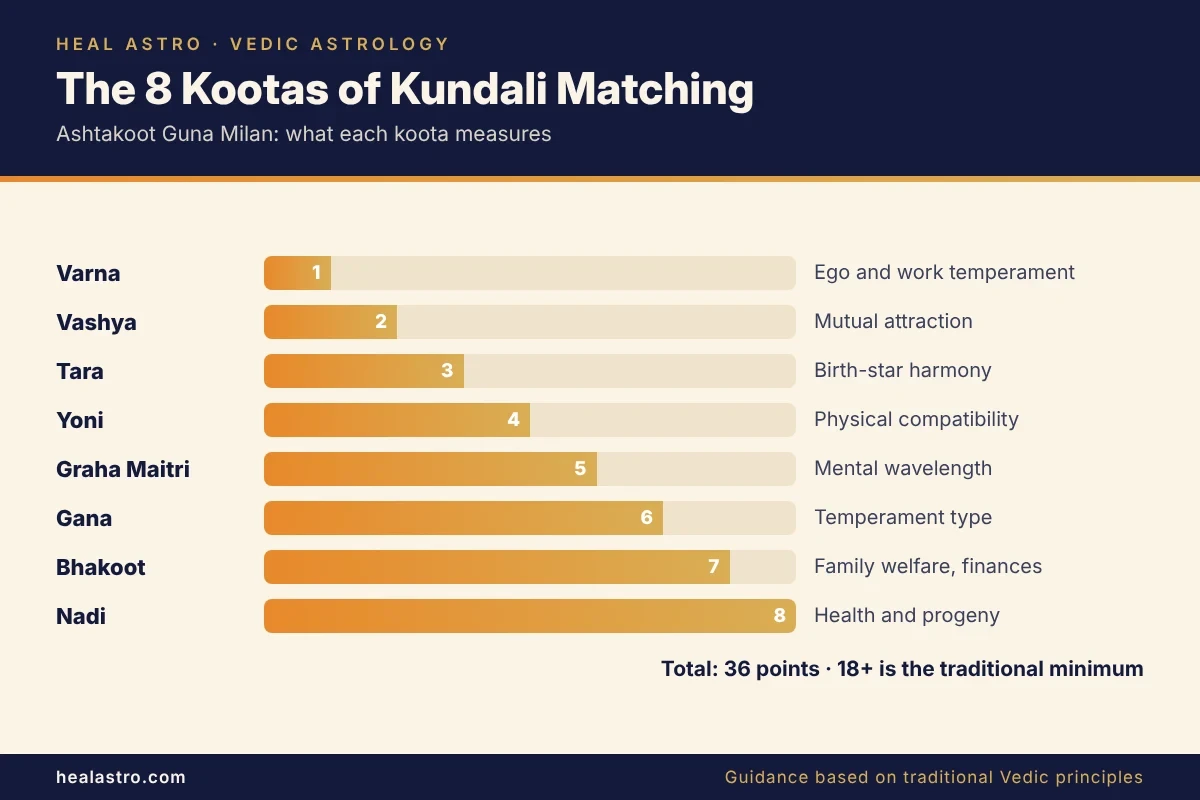
Traditional practice treats 18 out of 36 as the minimum for a match to be considered. A rough guide many astrologers use:
These bands are conventions, not scripture. Two matches with the same 24 can be very different once you look at which kootas scored and which didn't.
These two doshas cause the most anxiety in matching because they carry 15 of the 36 points between them. Both have well-known exceptions.
Nadi dosha happens when both partners have the same nadi (Aadi, Madhya or Antya), which scores zero out of eight. It is traditionally linked to health and progeny. It is commonly considered cancelled when both share the same Moon sign but different nakshatras, the same nakshatra but different padas, or when the Moon-sign lords are the same or friends.
Bhakoot dosha happens when the two Moon signs sit in a 6-8, 9-5 or 2-12 relationship. It is linked to financial strain and family friction. It is commonly considered cancelled when the Moon-sign lords are the same or mutual friends.
The Ashtakoot score uses only the Moon positions of the two people. That is its strength (it's simple) and its weakness (it ignores most of the chart).
Here is what an experienced astrologer adds:
Want all of this in writing? Order a Match Making Kundali Report
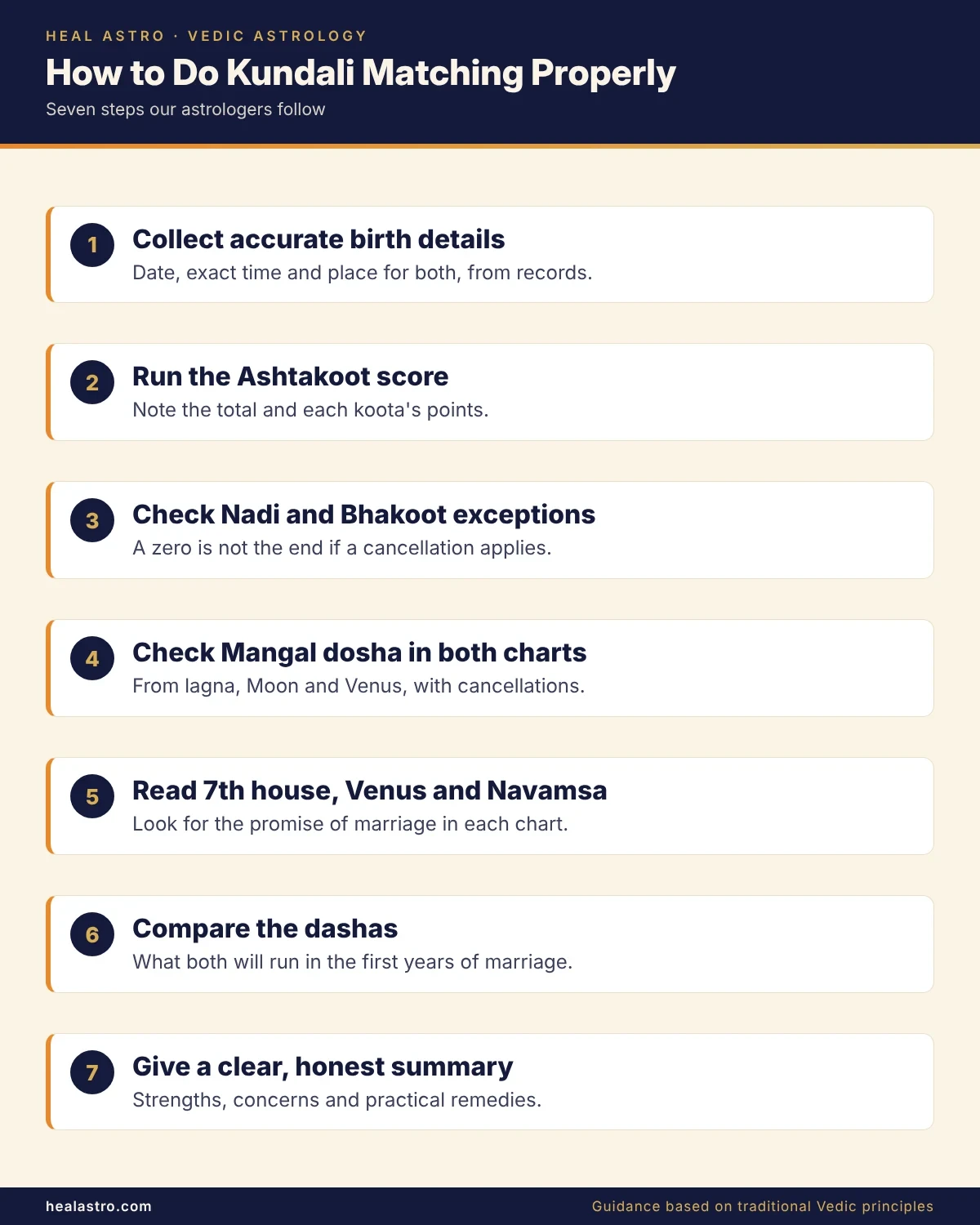
This is the sequence our astrologers follow when a family brings two charts to us.
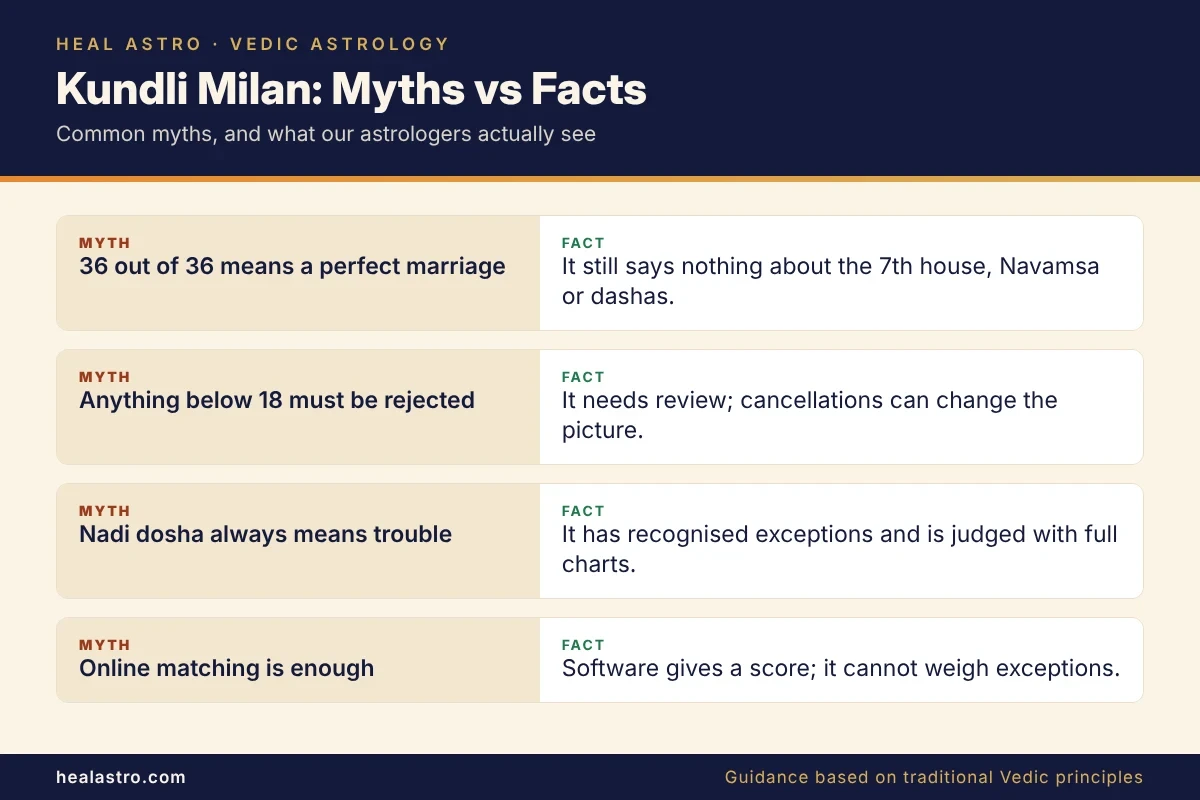
Matching has picked up a lot of myths. These are the ones that cause the most unnecessary heartbreak.
| Myth | Fact |
|---|---|
| 36 out of 36 means a perfect marriage | A perfect score is rare and still says nothing about the 7th house, Navamsa or dashas. |
| Anything below 18 must be rejected | Below 18 needs careful review. Cancellations and strong individual charts can change the picture. |
| Nadi dosha always means health problems or no children | Nadi dosha has several recognised exceptions and is judged with the full charts. |
| A Manglik must marry a Manglik | That is one traditional remedy. Cancellation rules often remove the dosha entirely. |
| Online matching is enough | Software gives the score. It cannot weigh exceptions or read both charts together. |
| Love marriages don't need matching | Many couples in love marriages still match kundlis to understand strengths and plan remedies. |
Many websites present the guna score as a pass-or-fail verdict. We disagree. The score is a starting point. Treating it as final has ended many good matches and approved some poor ones.
This is an illustrative example, not a real client.
Consider a match between a 28-year-old man from Lucknow and a 26-year-old woman from Kolkata. The online score: 17 out of 36. Bhakoot scored zero because their Moon signs were in a 6-8 relationship.
On review, both Moon signs, Aries and Scorpio, are ruled by Mars. Under the standard rule, Bhakoot dosha is cancelled when the sign lords are the same. Counting that, the effective picture moves well above 18. Neither chart has Mangal dosha. Both 7th lords are well placed, and the woman's Navamsa shows a strong Venus. The man starts Jupiter mahadasha a year after the planned wedding.
An astrologer reviewing this would likely call it a good match with one area to watch, the 6-8 Moon relationship, which can show up as differences in emotional style. Practical advice would be open communication and, if the families wish, a Gauri Shankar puja for marital harmony.
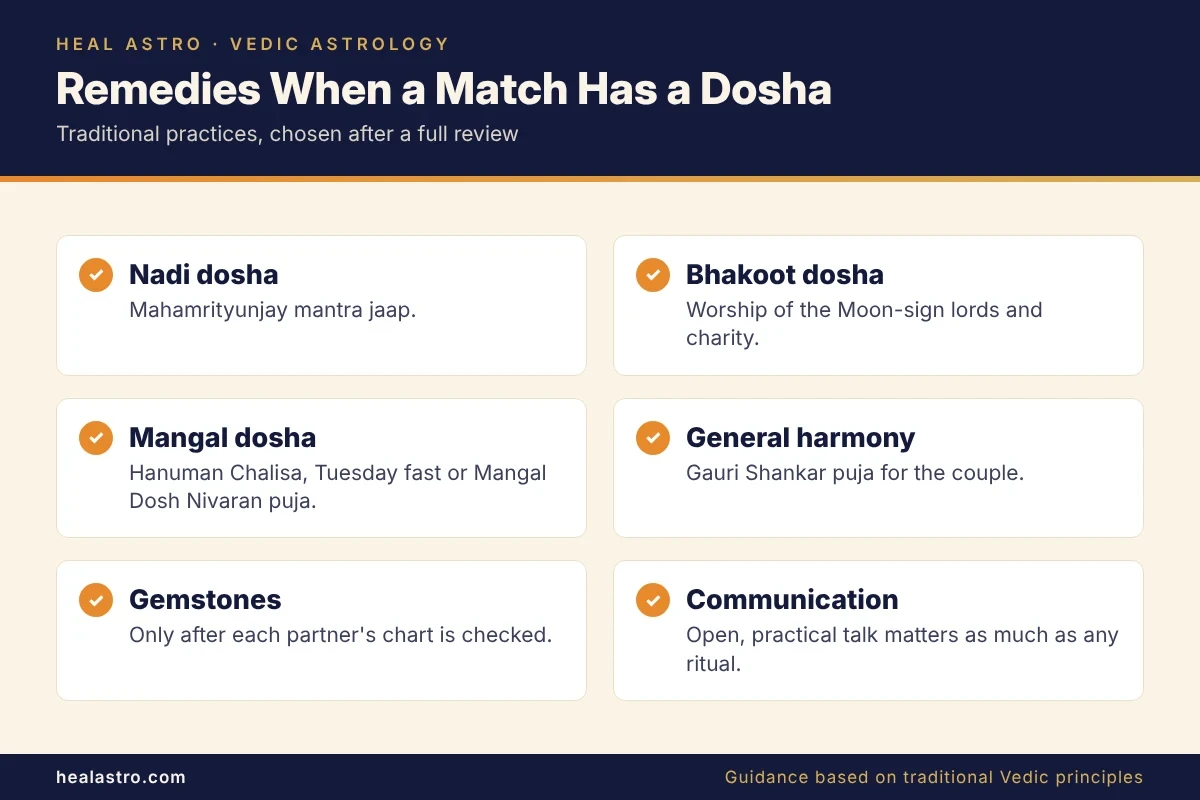
Remedies are traditional practices and acts of faith that many families find reassuring. They cannot promise a particular outcome, and they should only be considered after a full review.
Families in Delhi NCR, Lucknow, Kolkata, Jaipur, Chandigarh, Hyderabad and Pune often have the two sides living in different cities. Online matching handles that easily. Both sets of birth details are all an astrologer needs, and the consultation can include both families on one call.
It is also discreet. Many families prefer to get an independent view before the next meeting, without involving the local pandit until they are sure. If calling isn't convenient, you can ask your matching questions over chat.
At least 18 out of 36 gunas is the traditional minimum in kundali matching. Scores of 25 to 32 are considered good, and above 32 very good. However, the total alone is not enough. Nadi and Bhakoot exceptions, Mangal dosha and each person's 7th house can change the final assessment significantly.
No, Nadi dosha is not always a problem. It is commonly considered cancelled when both partners share a Moon sign but have different nakshatras, share a nakshatra but different padas, or have the same or friendly Moon-sign lords. Our astrologers check these exceptions before treating it as active.
Basic guna milan can be done with the Moon sign and nakshatra, which usually need only the birth date and approximate time. Mangal dosha, 7th house and Navamsa checks need an accurate birth time. Without it, the matching is incomplete, and we say so clearly in our reports.
A 36 out of 36 score is very rare, and it is not a guarantee of a perfect marriage. It only reflects Moon-based compatibility. The individual charts can still show difficulties in the 7th house or challenging dashas. A full kundali review is still recommended, even with a very high score.
Love marriages do not require kundli matching, but many couples choose it. It helps them understand areas of difference, check for doshas and pick an auspicious wedding date. It often reassures parents too, which can make family acceptance smoother.
Ashtakoot uses eight factors totalling 36 points and is common in North India. Dashakoot, or Porutham, uses ten factors such as Dina, Gana, Rajju and Vedha and is common in South India. Both compare Moon nakshatras, but they weigh different aspects of compatibility.
Remedies cannot change the score itself. They are traditional practices believed to ease the effect of specific doshas, such as Mahamrityunjay jaap for Nadi dosha. Before any remedy, an astrologer should check whether the dosha is actually active, because many are cancelled by chart exceptions.
Kundali matching is worth doing, and worth doing properly. Use the guna score as the first step, then look at doshas, the 7th house, the Navamsa and both partners' dashas before anyone decides.
If your match has a low score, a dosha, or simply a lot of family worry around it, speak to one of our astrologers. They will review both charts together and give you a clear, honest answer.
Talk to a HealAstro astrologer about your match
For a written, detailed view of the relationship, order the Marriage Compatibility Report, or read our guide to marriage prediction by date of birth.
Disclaimer: Astrology offers guidance based on traditional Vedic principles. It is not a substitute for medical, legal, financial or psychological advice, and no astrologer can guarantee an outcome.