
Key points at a glance
Your mother has already asked twice whether the Tulsi plant on the balcony will look good by Saturday. An aunt has a rishta in mind and says she will bring it up "after Tulsi Vivah". That is how this festival works in most Indian homes: a small, quiet puja at the front door, and a signal that families can start talking about shaadi again. This year Tulsi Vivah is on 21 November. Below we cover the date, the puja vidhi step by step, the katha, the samagri and what the festival does not mean for your own marriage timing. If a rishta is on your mind, you can also look at the auspicious dates and muhurat tool before any family meeting is fixed.
Planning a shaadi this season, start with a chart check. Get a marriage compatibility report from our astrologers before the dates are finalised.
Tulsi Vivah is the ceremonial marriage of the Tulsi plant, worshipped as the goddess Vrinda, to Lord Vishnu in his Shaligram form. It is held on Kartik Shukla Dwadashi, the day after Dev Uthani Ekadashi. Families dress the plant as a bride and perform the wedding rites at home or in a temple.
The ceremony is a mix of puja and a small family wedding. There is a mandap, there are songs, and there is prasad. Children often enjoy it the most, because they get to play the baraat.
Tulsi Vivah in 2026 is on Saturday, 21 November, on Kartik Shukla Dwadashi. Dev Uthani Ekadashi comes the day before, on Friday, 20 November. We checked both dates against Dekho Panchang and Hindutone, and both list Saturday, 21 November for Tulsi Vivah.
Two cautions. First, some families and temples observe the ceremony on a later day up to Kartik Purnima, and the date can shift by a day for readers abroad. Second, we have not printed a muhurat time here, because the Dwadashi timing changes with your city. Open the panchang for your city, note the Dwadashi timing for that day, and ask your family priest which day your tradition follows. If your family has always done it on a different day, keep to your own practice.
Tulsi Vivah is celebrated because it marks the end of Chaturmas, the four months when Lord Vishnu is said to rest, and the return of auspicious work. On Dev Uthani Ekadashi Vishnu wakes. The next day he is "married" to Tulsi, and families take that as the cue to begin things that were put off: weddings, griha pravesh, naming ceremonies.
The Tulsi plant itself sits in the courtyard or balcony of millions of homes and is watered every morning. Marrying her to Vishnu turns an everyday habit into a family event. That, more than any rule, is why the festival has lasted.
The Tulsi Vivah katha tells how Vrinda, the devoted wife of the demon king Jalandhar, became the Tulsi plant. In the Puranic accounts, Jalandhar was so strong that the gods could not defeat him as long as Vrinda's loyalty to him held. The gods asked Vishnu for help.
Vishnu took the form of Jalandhar and went to Vrinda. When she realised the deception, her faith in her husband was broken, and Jalandhar was killed in battle. Heartbroken, Vrinda cursed Vishnu to become a stone. That stone is the Shaligram. She then gave up her life, and from the place where she did, the Tulsi plant grew. Vishnu accepted her as the most beloved of plants and promised to marry her every year in his Shaligram form.
Accounts differ between the Puranas and between regions. Some tellings have a different name for the demon or a different end for Vrinda. We tell the version most families in north India hear at home.
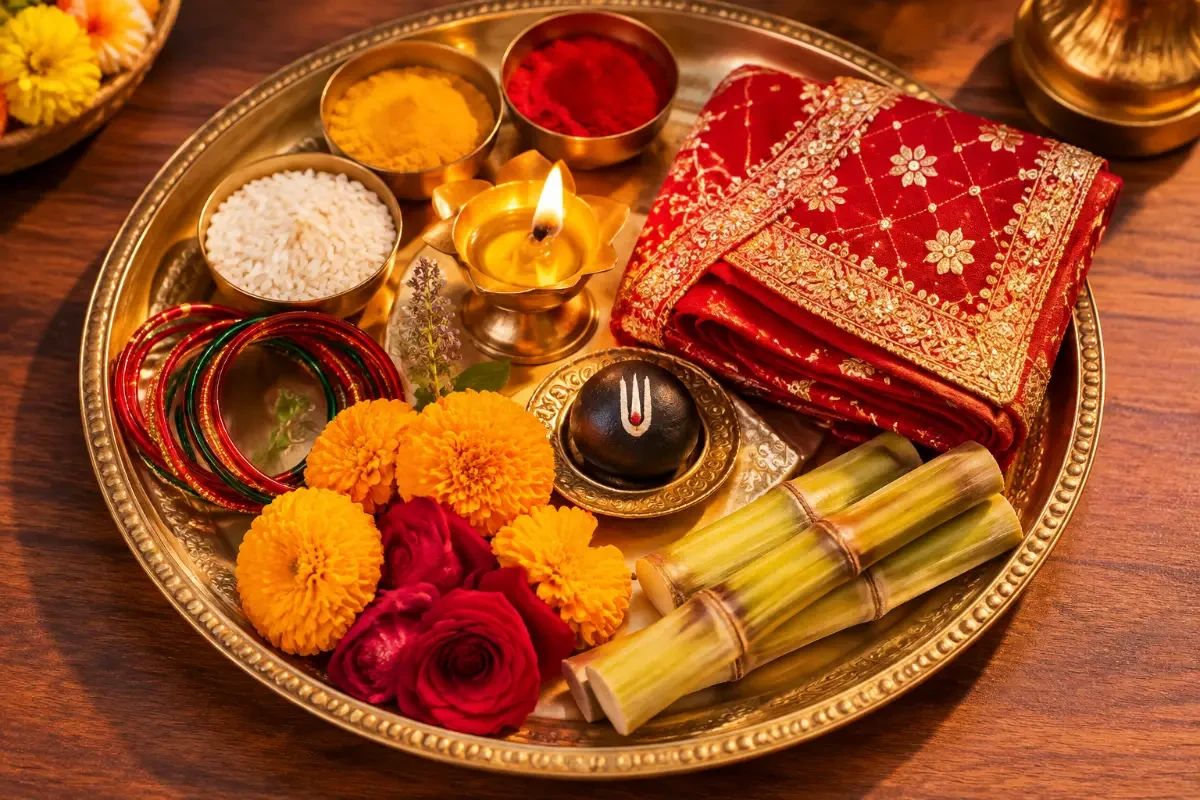
You need a healthy Tulsi plant, a Shaligram stone or a Vishnu image, and simple wedding items. Nothing here has to be expensive. A clean pot and sincere effort matter more than a costly mandap.
The Tulsi Vivah puja is done by dressing Tulsi as a bride, seating the Shaligram beside her, and performing the marriage rites with prayers and aarti. Families follow slightly different orders, so treat the steps below as a common home method, not the only one.
Many families do the ceremony in the evening, others in the morning. A fast on Ekadashi and a light meal on Dwadashi is common, but fasting is a personal choice, and nobody should fast against medical advice.
| Detail | What to know |
|---|---|
| Tithi | Kartik Shukla Dwadashi |
| Date in 2026 | Saturday, 21 November |
| Comes after | Dev Uthani Ekadashi, Friday, 20 November |
| Deities | Tulsi (Vrinda) and Vishnu as Shaligram |
| Observed until | Some families continue up to Kartik Purnima |
| Time of puja | Morning or evening, by family tradition |
| Main items | Tulsi, Shaligram, red chunri, sugarcane, diya |
| Who can do it | Any household member, with or without a priest |
For wedding planning in the weeks after, keep the panchang page open when you talk to the pandit.
Tulsi Vivah opens the wedding season, but it does not make any date suitable for any couple. Many websites call the weeks after it a "wedding muhurat for everyone". We disagree. A date is chosen from the panchang, and then it is checked against the two kundlis.
Here is what our astrologers look at first. Kundli matching comes before roka, because the Ashtakoota score and the doshas can change a family's decision. If you are new to the idea, read what kundli matching is and why families rely on it. If one kundli shows Mars in the 1st, 4th, 7th, 8th or 12th house, the family usually asks about Manglik dosha, how to check it and the common remedies. A low score on the Nadi koota raises a separate question, which we explain in our guide to Nadi dosha.
Then there is timing. The 7th house shows marriage, Jupiter and Venus are the planets traditionally studied for it, and the running dasha decides when a proposal is likely to move. Our guide to the 12 houses in Vedic astrology explains the 7th house in plain words, and our post on marriage prediction by date of birth shows how a chart is read for timing.
One honest limitation. All of this depends on an accurate birth time. If your birth time is off by 15 to 20 minutes, the lagna can change and the 7th house reading with it. If you are not sure, tell the astrologer, and ask for a birth-time check before any decision.
This is an illustrative example, not a real client. A family in Jaipur wanted to fix their daughter's shaadi right after Tulsi Vivah because "the season starts now". The kundlis were matched. The Guna Milan score was acceptable, but the girl's chart had Mars in the 7th house and the boy's chart had no Mars influence on the 1st, 4th, 7th, 8th or 12th.
Our astrologers did not say "go" or "stop". They explained that this combination is read with other factors in the chart, listed the traditional remedies, and suggested the family wait for the next suitable window after checking the dasha timing for both. The family chose a date in the following month. The point of the example is that the festival opened the conversation, and the kundli answered it.
The common myths are that Tulsi Vivah is a legal or astrological wedding, that it guarantees a good marriage, and that it can only be done on one fixed day. The facts below separate faith practice from chart reading.
| Myth | Fact |
|---|---|
| Tulsi Vivah makes every day after it a good wedding date. | It marks the start of the season. Each couple's date still depends on the panchang and the kundlis. |
| Doing the puja guarantees a good marriage. | It is a devotional practice. No puja can guarantee an outcome. |
| It must be done on exactly one day. | Families follow their own tradition, and some continue up to Kartik Purnima. |
| You need a Shaligram. | Many homes use a Vishnu or Krishna image when they have no Shaligram. |
| Only women can perform it. | Any member of the household can do it. |
| The plant must be a large one. | A healthy plant in a small pot is enough. |
Families follow a few simple practices that are acts of faith, not guaranteed remedies. They are safe for most people and do not need any expensive item.
If you would like a mala for daily japa, you can look at our jap mala collection. If you are curious about rudraksha as well, our guide on which rudraksha to wear, from 1 to 14 mukhi explains what is traditionally said about each, and we advise a chart check before you choose one. For a personal puja done on your behalf, you can also look at our love and relationship pujas.
Talk to a HealAstro astrologer about your wedding timing if you want a clear opinion on your kundli before dates are fixed.
Yes, an online consultation works just as well as a visit. Readers from Delhi NCR, Mumbai, Jaipur, Lucknow, Kolkata, Bengaluru and Hyderabad send us their birth details, and our astrologers study the chart the same way they would in person. You do not need to travel to Varanasi or sit in a waiting room.
What you need is your date, time and place of birth. If you have a printed kundli, keep it handy. If you do not, our astrologers can prepare one from your details. Having both partners' details ready before the first call saves time.
Tulsi Vivah is on Saturday, 21 November 2026. It falls on Kartik Shukla Dwadashi, the day after Dev Uthani Ekadashi on Friday, 20 November. Some families observe it on later days up to Kartik Purnima, so confirm with your family priest and check the Dwadashi timing for your city on a panchang.
Tulsi Vivah is celebrated to mark the end of Chaturmas and the return of auspicious work. Vishnu wakes on Dev Uthani Ekadashi, and the next day Tulsi, who became a plant after the katha of Vrinda, is married to him in his Shaligram form. It is a tradition and an act of faith.
Dress Tulsi in red, build a sugarcane mandap and place a Shaligram or Vishnu image beside her. Offer haldi, kumkum, flowers and akshat, perform the marriage rite, then do aarti and share the prasad. The ceremony takes about an hour at home, and a family priest can guide the mantras.
You need a Tulsi plant, a Shaligram or Vishnu image, a red chunri and shringar items, haldi, kumkum, akshat, flowers, sugarcane stalks, fruit, sweets, a diya, ghee, incense and a kalash of clean water. A simple version with these items is enough, and no costly item is required.
Many families start fixing wedding dates after Tulsi Vivah, because the four months of rest are over. That does not make every date suitable. Each wedding date is chosen from the panchang and checked against both kundlis, and any dosha or dasha question is settled before the date is fixed.
Yes, any member of the household can perform it. You do not need a priest, though a family elder or pandit can guide the order and the mantras. Keep the plant healthy, keep the area clean, and follow your own family practice for the day and time.
Yes, many homes use a Vishnu or Krishna image or a small idol when they do not have a Shaligram. What matters in the tradition is the devotion and the clean preparation. If you want to buy a Shaligram, ask your family priest which one is appropriate before you choose.
Tulsi Vivah is a quiet festival that opens a busy season. Enjoy the puja, keep the plant well, and treat the weeks after it as a time to ask the right questions about your own shaadi. Get your marriage compatibility report from our astrologers if a proposal is already on the table. If you prefer to talk, you can also download the HealAstro app on Android and speak to an astrologer from home.
Disclaimer: Astrology offers guidance based on traditional Vedic principles. It is not a substitute for medical, legal, financial or psychological advice, and no astrologer can guarantee an outcome.