
Key points at a glance
Every shaadi (marriage) season, the same question comes up at the kundli-milan table: which dasha is running? Parents ask it when a son's job search drags on at 27. They ask it again when a daughter's rishta talks stall at 29. The answer sits in the kundli (birth chart), and it is the most practical timing tool in Vedic astrology. Where a planet sits, which our guide to the 12 houses in Vedic astrology explains in detail, shows what that planet can deliver. The mahadasha shows when it gets its turn. Below we explain how the periods are calculated, how our astrologers read them, what they cannot tell you, and which upay (traditional remedies) are reasonable.
Want your own period dates mapped out year by year? Get your 5-Year Prediction Report
A mahadasha is a major planetary period in Vedic astrology, during which one planet leads the results of your life. In the Vimshottari system, which most astrologers use, nine mahadashas run in a fixed order and add up to 120 years. Your birth Moon's nakshatra decides where your own sequence begins.
The word joins maha (great) and dasha (period). Brihat Parashara Hora Shastra describes several dasha systems, but Vimshottari is the one most practising astrologers rely on, so it is the one we use here. The planet whose period is running is called the dasha lord.
The nine mahadashas always follow one sequence: Ketu, Venus, Sun, Moon, Mars, Rahu, Jupiter, Saturn, Mercury, and then back to Ketu. Each planet rules three nakshatras, spaced a trine apart, and the table shows which.
| Order | Planet | Years | Nakshatras it rules |
|---|---|---|---|
| 1 | Ketu | 7 | Ashwini, Magha, Mula |
| 2 | Venus | 20 | Bharani, Purva Phalguni, Purva Ashadha |
| 3 | Sun | 6 | Krittika, Uttara Phalguni, Uttara Ashadha |
| 4 | Moon | 10 | Rohini, Hasta, Shravana |
| 5 | Mars | 7 | Mrigashira, Chitra, Dhanishta |
| 6 | Rahu | 18 | Ardra, Swati, Shatabhisha |
| 7 | Jupiter | 16 | Punarvasu, Vishakha, Purva Bhadrapada |
| 8 | Saturn | 19 | Pushya, Anuradha, Uttara Bhadrapada |
| 9 | Mercury | 17 | Ashlesha, Jyeshtha, Revati |
| Total | 120 |
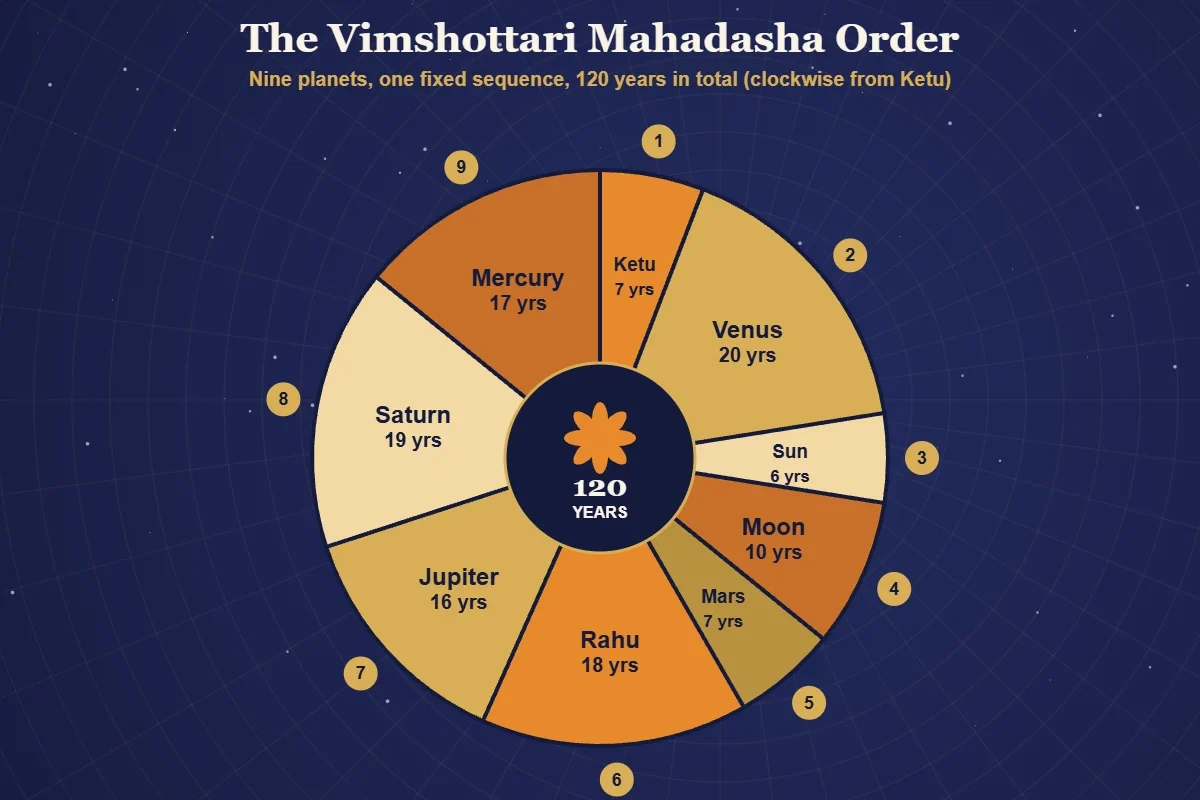
Nobody lives through all 120 years, so you enter the cycle part-way. Venus is the longest period at 20 years. The Sun is the shortest at 6.
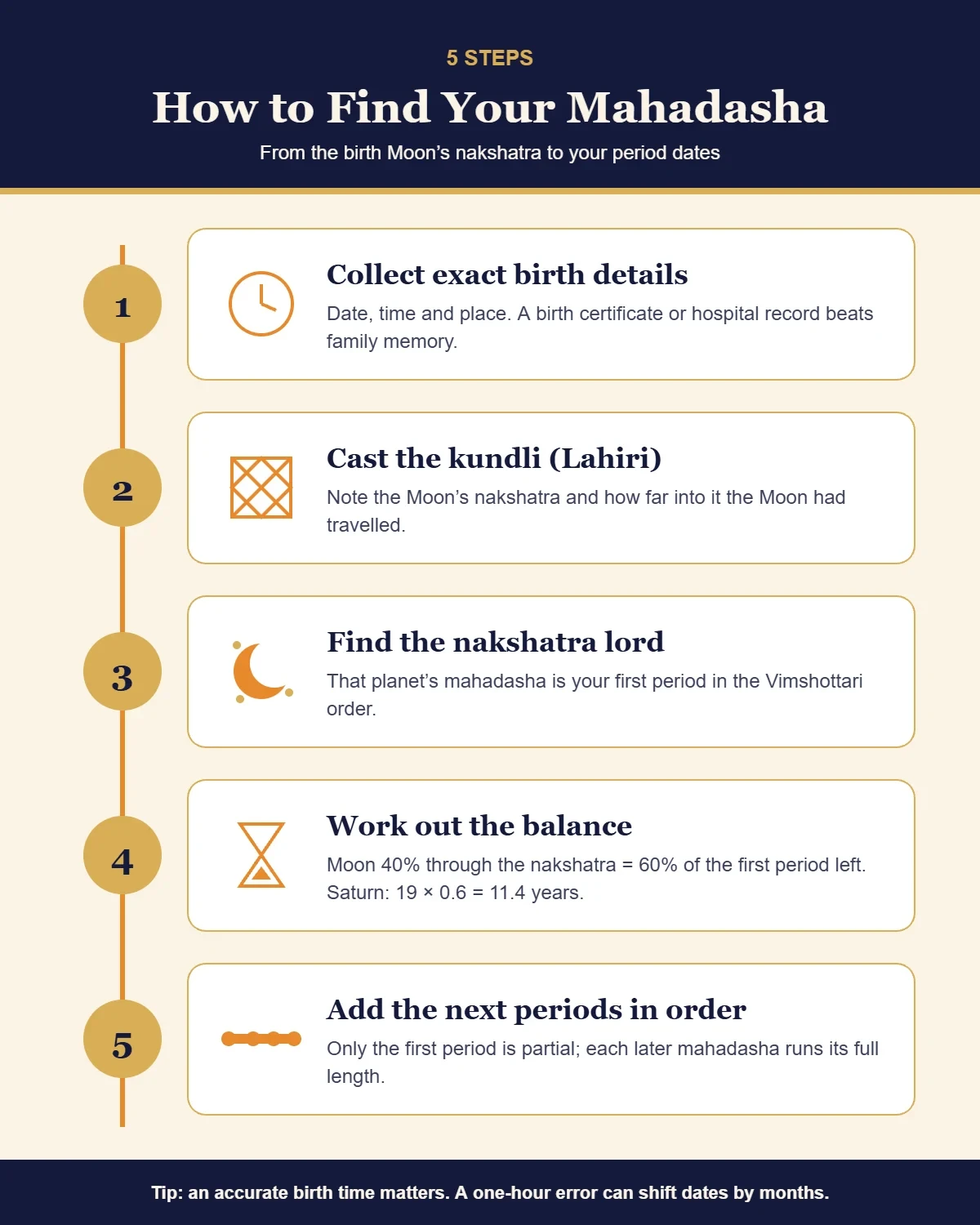
You find your starting period by locating your Moon's nakshatra at birth and counting forward through the fixed planetary order. Our astrologers do it like this.
An antardasha, also called bhukti, is a sub-period inside a major period, and it usually decides the year in which an event shows up. Each major period divides into nine antardashas in the same planetary order, beginning with the dasha lord itself. The length is the main period's years multiplied by the sub-lord's years, divided by 120.
Here is a Saturn mahadasha (19 years) worked out for four of its nine sub-periods:
| Antardasha | Working | Length |
|---|---|---|
| Saturn-Saturn | 19 × 19 ÷ 120 | about 3 years |
| Saturn-Mercury | 19 × 17 ÷ 120 | about 2 years 8 months |
| Saturn-Ketu | 19 × 7 ÷ 120 | about 1 year 1 month |
| Saturn-Venus | 19 × 20 ÷ 120 | about 3 years 2 months |
Below the antardasha sits the pratyantardasha, which is split the same way and runs for weeks or months. Most readings stay at antardasha level and use the smaller layer only when a particular month matters.
Many websites read only the dasha lord. We think that misses half the picture. Two people in the same Jupiter period can have very different years because one is in Jupiter-Rahu and the other in Jupiter-Venus.
Each dasha lord has traditional themes, but the real result depends on that planet's house, sign and strength in your own chart. Treat this list as a starting point.
We read a mahadasha by checking where the dasha lord sits, which houses it rules, how strong it is, and what else is active at the same time.
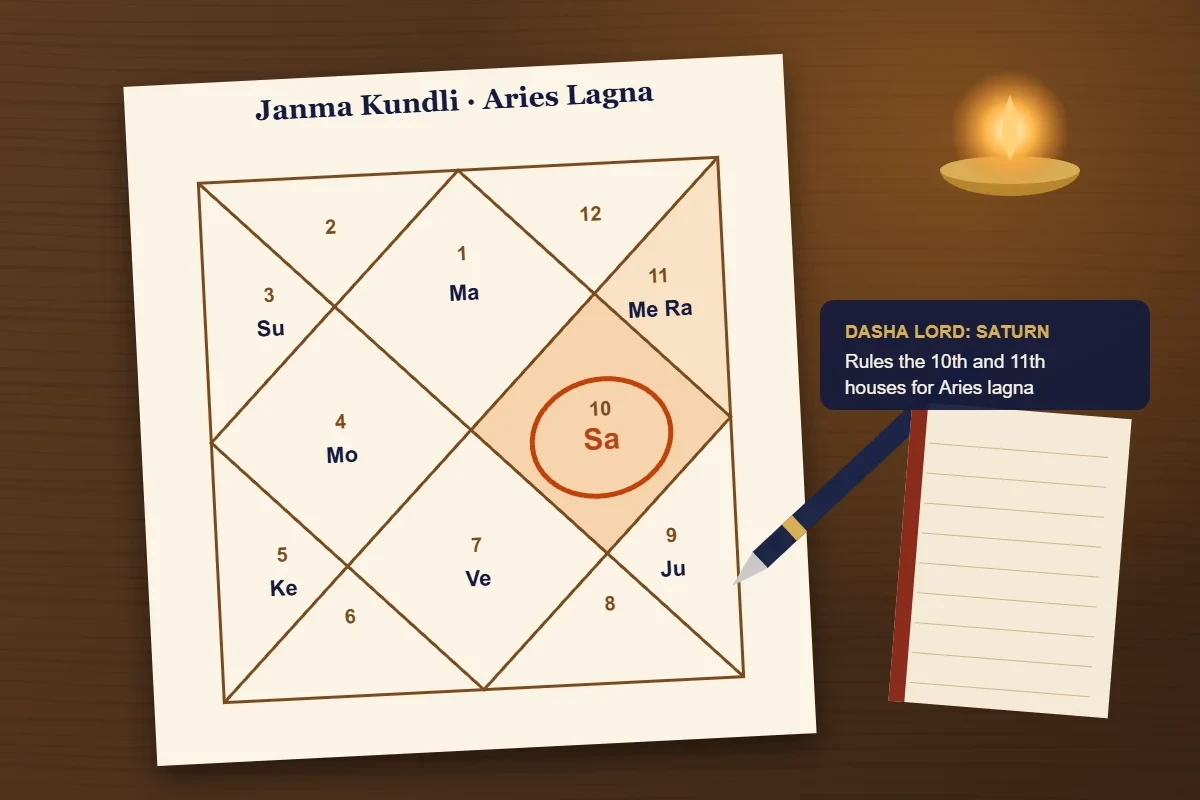
Take Saturn. For an Aries lagna (ascendant), Saturn rules the 10th and 11th houses, so Saturn's period turns attention to career and income. For a Cancer lagna, Saturn rules the 7th and 8th, and the same period leans toward partnership and sudden change. Same planet, two different stories. This is why any generic "Saturn period" article, ours included, can only be a starting point.
A planet in its own or exalted sign delivers more cleanly than one in debilitation or sitting very close to the Sun. We also check the Navamsa (D9) chart. A planet that looks fine in the main chart but weak in the Navamsa is traditionally read as giving less than it promises.
A Shani period that overlaps with Sade Sati feels heavier than either alone, and our guide to the phases of Sade Sati shows how to tell where you stand. If your chart carries a dosh (affliction) such as Mangal or Kaal Sarp, that dosh tends to speak up in the dasha of the planet involved. The planetary doshas guide explains how to spot one. For a wider view of reading a whole chart, start with the beginner's guide to reading a kundli.
Every date in a dasha table depends on your birth time, and many families only know it to the nearest hour. The Moon travels roughly half a degree in an hour. A one-hour error moves the starting balance by about 4 percent of the first period, which is around nine months for a 19-year Saturn period, and every later date moves with it. If your birth time is a guess, say so. A good astrologer can test it against past events before reading forward.
Not sure which period you are in? Talk to astrologers with your birth details ready.
Most worry about dashas comes from a few repeated claims. Here is what we tell people in consultations.
| Myth | Fact |
|---|---|
| Rahu and Shani mahadashas are always bad. | Both are demanding, not doomed. A well-placed Saturn rewards steady work and a well-placed Rahu can bring ambition and foreign links. We disagree with sites that call these periods punishment. |
| Everyone born on the same day has the same dasha. | Dates depend on the Moon's exact position, so a few hours' difference in birth time can shift your periods by months. |
| Only the dasha lord matters. | The antardasha lord and the houses involved often decide when and how an event appears. |
| A weak planet's period means you must buy its gemstone. | A stone strengthens the planet whether the planet helps you or not. We suggest gemstones only after a chart check. |
| A dasha can predict an exact date. | It points to windows of months or years. It cannot promise an event on a particular day. |
This example is illustrative. It is not a real client.
Take a woman we will call Priya, born with Aries lagna and the Moon in Cancer, in Pushya nakshatra. Pushya is ruled by Saturn, so her first mahadasha is Saturn. Say the Moon had crossed 40 percent of Pushya at birth. Sixty percent of 19 years is 11.4 years, so she was born with about 11 years 5 months of Saturn left.
Her sequence then runs: Saturn to age 11.4, Mercury to 28.4 (17 years), Ketu to 35.4 (7 years), and Venus to 55.4 (20 years). The family's rishta talks begin around 28, just as Mercury ends and Ketu begins. Ketu years can feel like closed doors for marriage, and parents often panic.
Here is how we would read it. For an Aries lagna, Venus rules the 7th house of marriage, and her Venus mahadasha starts at 35.4. Inside Ketu, the Ketu-Venus antardasha runs 7 × 20 ÷ 120, about 1 year 2 months, beginning after the 5-month Ketu-Ketu sub-period, so from roughly age 29 to 30. That is the first window we would check for marriage talks, subject to where Venus actually sits and how strong it is. It is a reading of timing, not a verdict.
Traditional remedies for a hard period are simple acts of faith, and they do not guarantee any result. These are the practices families commonly follow:
If your family prefers a formal ritual, a one-to-one Grah Dosh puja can be arranged. We recommend a gemstone only after a chart check, because a stone strengthens a planet whether that planet is helping you or not.
A mahadasha reading works just as well online as in person, because it rests on your birth details and not on where you sit. Readers in Delhi NCR, Mumbai, Jaipur, Lucknow, Kolkata, Bengaluru and Pune speak to our astrologers by call or chat every day. Share your birth date, time and place beforehand, keep a note of two or three past events (a job change, a move, a rishta), and the astrologer can test your dasha dates against them before reading forward.
The main planetary period is the mahadasha, and an antardasha is a sub-period inside it. The dasha lord sets the broad theme for 6 to 20 years, while each antardasha, lasting from a few months to about three years, shows which part of that theme comes forward. Together they point to the timing of events.
Enter your exact birth date, time and place in a kundli calculator and read the dasha table it produces. The table lists each mahadasha with start and end dates, and the one covering today's date is your current period. Birth time accuracy matters, so confirm it from your birth certificate or hospital record before relying on the dates.
Venus has the longest period at 20 years, and the Sun has the shortest at 6 years. The full Vimshottari cycle runs 120 years, so Saturn takes 19, Rahu 18, Mercury 17, Jupiter 16, the Moon 10, and Mars and Ketu 7 each. Nobody lives through all of them, because you enter the cycle part-way.
No, neither is always bad. Both are demanding planets, but results depend on the planet's house, sign, strength and the antardasha running. A well-placed Saturn can reward years of steady work, and a well-placed Rahu can bring ambition and foreign links. A weak placement needs care, not panic, and a chart check shows which case applies to you.
No single period suits everyone, because it depends on your chart. For marriage, astrologers look at the period of the 7th lord, Venus and any planet in the 7th house. For career, they look at the 10th lord and planets in the 10th. A supportive dasha lord together with a matching antardasha gives the best timing window.
Yes, and it can shift every date in your chart. The Moon moves roughly half a degree in an hour, so an error of one hour moves the starting balance by about 4 percent of the first period, which is around nine months for a 19-year Saturn period. An astrologer can test the time against past events to narrow it down.
Remedies cannot guarantee a change in results. In the Vedic tradition, mantra, charity and puja are acts of faith that many families use to stay steady during a hard period. We suggest them alongside practical effort, never in place of medical, legal or financial advice. A chart check shows which practices suit your situation.
Your mahadasha tells you which planet's themes are in front right now. It does not tell you to wait, to panic or to spend on a stone. Use it the way a family uses a muhurat: as one input beside effort, savings and plain good sense. Reading a horoscope before big decisions is an old habit for good reason, and our piece on why people read their horoscope before important decisions explains what it can and cannot do.
If you want the next five years laid out with antardasha windows marked, the report linked near the top of this page does that. For a longer view that covers two or more major period changes, get the 10-Year Prediction Report. And if you want us one tap away, the HealAstro app on Google Play is there for that.
Disclaimer: Astrology offers guidance based on traditional Vedic principles. It is not a substitute for medical, legal, financial or psychological advice, and no astrologer can guarantee an outcome.