Key points at a glance
A father in Lucknow calls us before his daughter's roka. Three rishtas have fallen through in a year, her Saturn period has just started, and a relative has told him "do a big puja immediately." He wants to know one thing: is a grah shanti puja actually needed, or is someone selling him fear? We hear this question every week. Before you book any puja, it helps to understand what planetary doshas in a kundli really are and how to separate a real affliction from a passing bad phase. This guide gives you that, plus the vidhi, simple home upay, and the honest limits.
Talk to our astrologers about your chart before you book any puja: Talk to Astrologers
Grah shanti puja is a Vedic ritual in which a priest invokes the nine planets (Surya, Chandra, Mangal, Budh, Guru, Shukra, Shani, Rahu and Ketu) through mantras, havan (fire offering) and daan (charity), asking for their influence to be calmer in your life. "Grah" means planet and "shanti" means pacification. The ritual does not change your birth chart. It is a prayer and a discipline, practised in India for centuries as an upay (remedy) alongside conduct and effort.
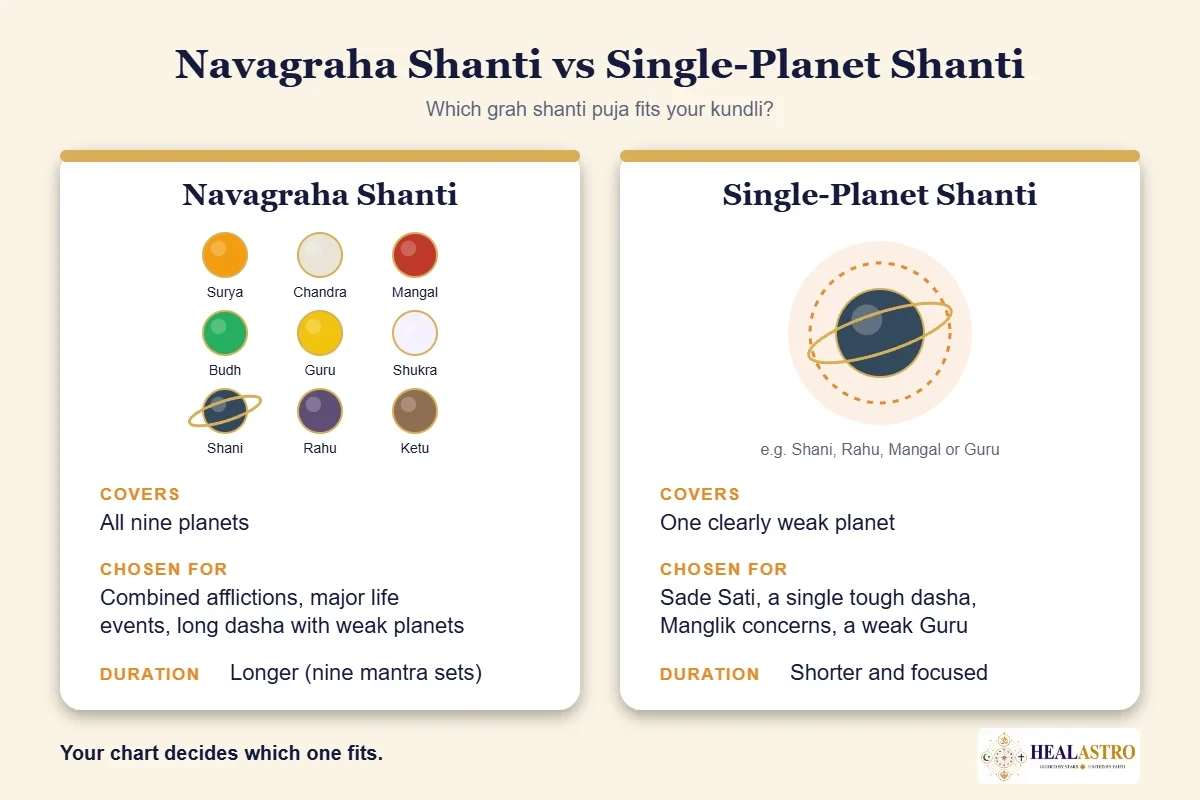
You will also see it written as graha shanti or navagraha shanti. The names overlap, though a navagraha shanti normally means all nine planets, while a grah shanti can be done for one.
You need it when a chart check shows a specific planetary problem, not simply because life feels hard. Many sites say a rough year means you must do a puja. We disagree. A struggling year can come from job markets, family health or plain timing, and a puja is worth doing only when the kundli points to a cause.
Our astrologers look for these signs, in roughly this order:
If none of these show up, we usually say so and suggest simpler habits. That honesty is the point of a consultation.
Choose a single-planet shanti when one planet is clearly the problem, and a full navagraha shanti when several planets are weak or when the chart shows a combined affliction. The choice depends on the chart, the phase running and the question you want help with.
It is chosen for combined afflictions, a major life change such as a new house, a marriage, or a long Mahadasha with several weak planets. Nine planets mean nine sets of mantra and nine daan items, so it takes longer.
A Shani shanti for Sade Sati, a Rahu shanti during Rahu Mahadasha, a Mangal shanti for Manglik concerns, or a Guru shanti when Jupiter is weak. It is shorter and more focused.
A grah shanti is not the same as a Pitra dosh puja (for ancestors) or a Kaal Sarp puja (for one named pattern). If your chart shows a pitra issue, Pitra Dosh Nivaran Puja is the better fit.
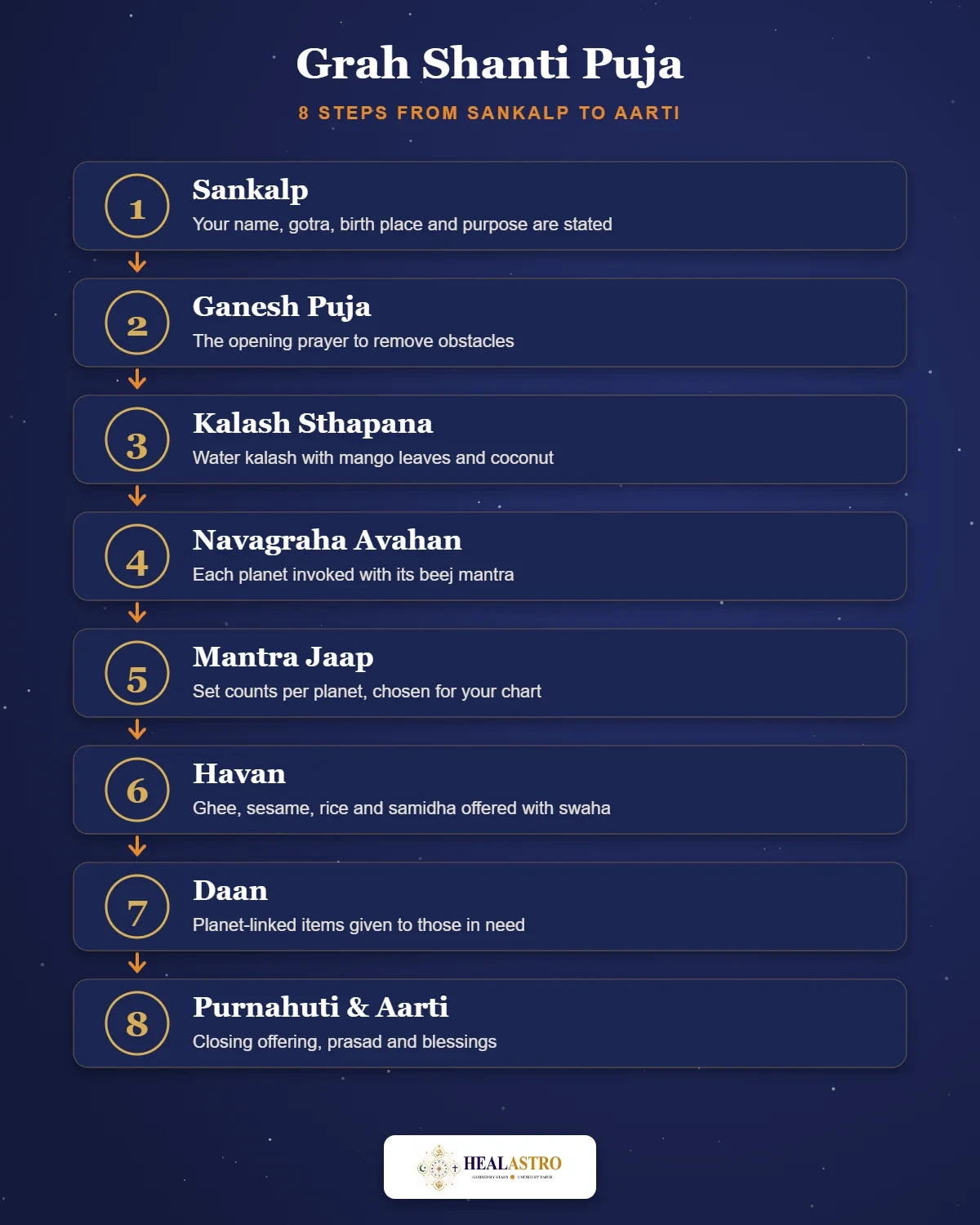
A grah shanti puja follows a set order: sankalp, ganesh puja, kalash sthapana, planet invocation, mantra jaap, havan, daan and aarti. Details vary by priest and tradition (classical texts such as Brihat Parashara Hora Shastra describe the navagraha and their remedies, while the exact vidhi follows regional pooja paddhati). This is the usual sequence.
Want a priest to perform it with your sankalp? See our one-to-one Grah Dosh puja options
Most confusion comes from fear marketing, so it helps to separate what tradition says from what gets sold. These are the claims we hear most.
| Myth | Fact |
|---|---|
| A grah shanti puja removes all problems. | It is a prayer and discipline. It cannot guarantee any outcome. |
| Everyone with a dosh must do a big puja. | Many doshas are cancelled or mild. A chart check decides. |
| Only a temple puja works. | What matters is the sankalp in your name and a qualified priest, not the location. |
| More expensive means more effective. | Cost does not equal result. A short, correct single-planet shanti can fit better than a grand ritual. |
| One puja is enough and nothing else is needed. | Tradition pairs puja with conduct, charity and, where advised, regular mantra. |
| A gemstone does the same job. | A gemstone is a separate remedy and is advised only after a chart check. |
Simple, safe habits support the puja, and you can begin them today at no cost. They are traditional practices and acts of faith, nothing more.
We recommend gemstones, rudraksha or yantras only after a chart check, because a wrong stone can do more harm than good.
This example is illustrative and not a real client story. A woman in her early thirties reaches us with delayed marriage. Her kundli shows Saturn in the 7th house in Libra, and her Rahu Mahadasha has just begun with Rahu placed in the 12th. Marriage proposals start and stall.
Our astrologers cross-check the Navamsa (D9) chart, because the 7th lord's strength there decides how much help the planet can really give. Here, Venus is average and Saturn is strong in the D9. So we would suggest a Rahu-Shani shanti rather than a full navagraha puja, along with weekly Saturday charity and a practical push on introductions. We would also tell her the limit: the puja does not decide the date of marriage, and her effort and family support still matter.
Yes, an online grah shanti puja works well when the priest takes the sankalp in your name and you can watch or take part by video. We hear from readers in Delhi NCR, Mumbai, Jaipur, Lucknow, Kolkata, Bengaluru and Hyderabad, many of whom live far from their home town or from a trusted priest. For them a video puja with proper sankalp saves travel and still follows the vidhi. Families in Pune, Indore and Patna ask the same thing, and the answer is the same: the quality of the priest and the accuracy of your birth details matter far more than the postal code.
One honest limitation: if your birth time is uncertain, ascendant-based conclusions may be off by a sign, and so may the planet choice. We tell you when the time needs rectification before any puja is fixed.
You can also check the basic planetary positions with our free kundli generator and read how to read your kundli to see what your chart shows before speaking to us.
Get your whole chart read before choosing a remedy: Complete Kundli Report
It is used to pacify weak or afflicted planets in a kundli. It is a traditional Vedic ritual of mantra, havan and charity for the nine planets, chosen for tough Mahadashas, doshas or repeated blocks. It is a faith practice and does not guarantee an outcome.
You know after a chart check, not by guesswork. We look for a difficult dasha, a named dosh, a weak or debilitated planet in the 6th, 8th or 12th house, or repeated blocks in one area. If these are absent, we usually advise simpler habits instead.
It varies by type. A single-planet shanti is shorter, and a full navagraha shanti takes longer because nine planets are invoked. The priest's tradition and the mantra counts chosen for your chart also change the time, so ask before booking.
Yes. An online puja works when the priest takes the sankalp with your name, gotra and birth details, and you can follow it by video. The accuracy of the sankalp and the qualification of the priest matter more than where it is performed.
It depends on the planet and the muhurat. Many families choose a day linked to the planet, such as Saturday for Shani, but the final date should come from a panchang check against your chart. Our free Panchang shows the day's tithi and nakshatra.
Not always. Navagraha puja means all nine planets, while grah shanti can be done for one planet, so the two overlap but are not identical. Your chart decides which suits you, and a priest should explain the choice before the day.
Follow your priest's instructions first. Many families keep a simple satvik meal, bathe early, wear clean clothes and avoid anger and argument on the day. These are customs of respect, not rules that guarantee anything, so do not worry if one slips.
No. Puja is a spiritual practice and never a substitute for professional help. If you face a health, legal or money problem, see a qualified doctor, lawyer or adviser first, and treat the puja as a prayer for strength alongside real action.
If your chart shows a real planetary problem, a grah shanti puja done with the right sankalp can be a calm, structured way to pray for steadiness. If it does not, we will say so. Either way, start with the chart, not with fear. Chat with our astrologers about your chart first, or keep us on your phone with the HealAstro app on Google Play.
Disclaimer: Astrology offers guidance based on traditional Vedic principles. It is not a substitute for medical, legal, financial or psychological advice, and no astrologer can guarantee an outcome.