
Key points at a glance
A woman in Jaipur once brought her late father's yellow sapphire ring to a jeweller, convinced it had "stopped working" after fifteen years. It hadn't stopped working. Nobody had ever checked whether her kundli called for it in the first place. That mix-up is common. People buy a pukhraj stone because a relative wore one, because a video said it brings luck, or because yellow looked auspicious in a shop window — and only later ask whether their own chart agrees.
Pukhraj is Jupiter's stone, and Jupiter rules wisdom, wealth, children and dharma. Worn well, it is believed to lift a weak or afflicted Jupiter. Worn blindly, our astrologers have seen it do nothing at all, or sit uncomfortably with a chart it was never suited to.
Not sure if your chart calls for a pukhraj stone? Chat with our astrologers for a chart check before you buy one.
A pukhraj stone is a natural yellow sapphire, a corundum gemstone governed by Jupiter (Guru) in Vedic astrology. It is worn as an upay, a traditional remedy, to strengthen a weak Jupiter or activate Jupiter's benefic results for a particular ascendant, after a qualified astrologer confirms the chart supports it.
Jupiter is Guru in the Navagraha, the nine planets of Vedic astrology, and it signifies gyan and sukha, knowledge and happiness. In Brihat Parashar Hora Shastra, Jupiter is treated as a natural benefic, one of the few planets whose results are, more often than not, welcomed.
The pukhraj stone belongs to Jupiter the way coral belongs to Mars or pearl belongs to the Moon. Each Navagraha has a matching gem, and wearing it is thought to channel that planet's energy more directly into the wearer's life. For Jupiter, that means confidence in decisions, a steadier relationship with money, and (many clients tell us) an easier time with teachers, mentors and legal matters.
None of that is automatic. A debilitated Jupiter, an afflicted Jupiter, or a Jupiter that is simply weak by placement behaves differently from a Jupiter that is already strong. Our astrologers look at where Jupiter sits, which house it rules, and what it aspects, before saying whether a pukhraj will help at all.
Broadly, a pukhraj stone suits a chart where Jupiter acts as a functional benefic, where it owns a kendra or trikona house (the 1st, 4th, 5th, 7th, 9th or 10th, as our guide to the 12 houses in Vedic astrology explains) for that ascendant, or where it is the yogakaraka for the lagna. It also tends to help when Jupiter is weak by sign, afflicted by a malefic's aspect, or running a dasha or antardasha where its support would matter.
A few situations our astrologers flag as good candidates:
We say "may" deliberately. Two people with similar-looking charts can get opposite advice, because the 9th lord for one ascendant is the 6th lord for another. That is why a pukhraj recommendation off a generic list, with no birth time checked, is advice we would not give ourselves.
For some ascendants (commonly cited are Taurus and Libra lagnas in several traditional texts, since Jupiter can behave as a maraka, a house-lord associated with difficulty, for them) astrologers are far more cautious about recommending yellow sapphire. The same caution applies when Jupiter already sits strong, exalted or in its own sign, with no affliction to correct: adding more Jupiter energy there can tip a good placement into excess, according to classical reasoning, rather than improve it. A chart going through Shani Sade Sati needs an even closer look, since Saturn's transit can change how Jupiter's support is actually felt during that period.
We would also add a limitation many sites skip: an incorrect birth time changes the ascendant, and a wrong ascendant can flip this advice entirely. If your time of birth was recorded loosely, as happens often with home births or rushed hospital paperwork, that uncertainty should be resolved before any gemstone decision, not after.
Tradition lays out a fairly consistent method across Jyotish practitioners, even if small details vary by family or region.
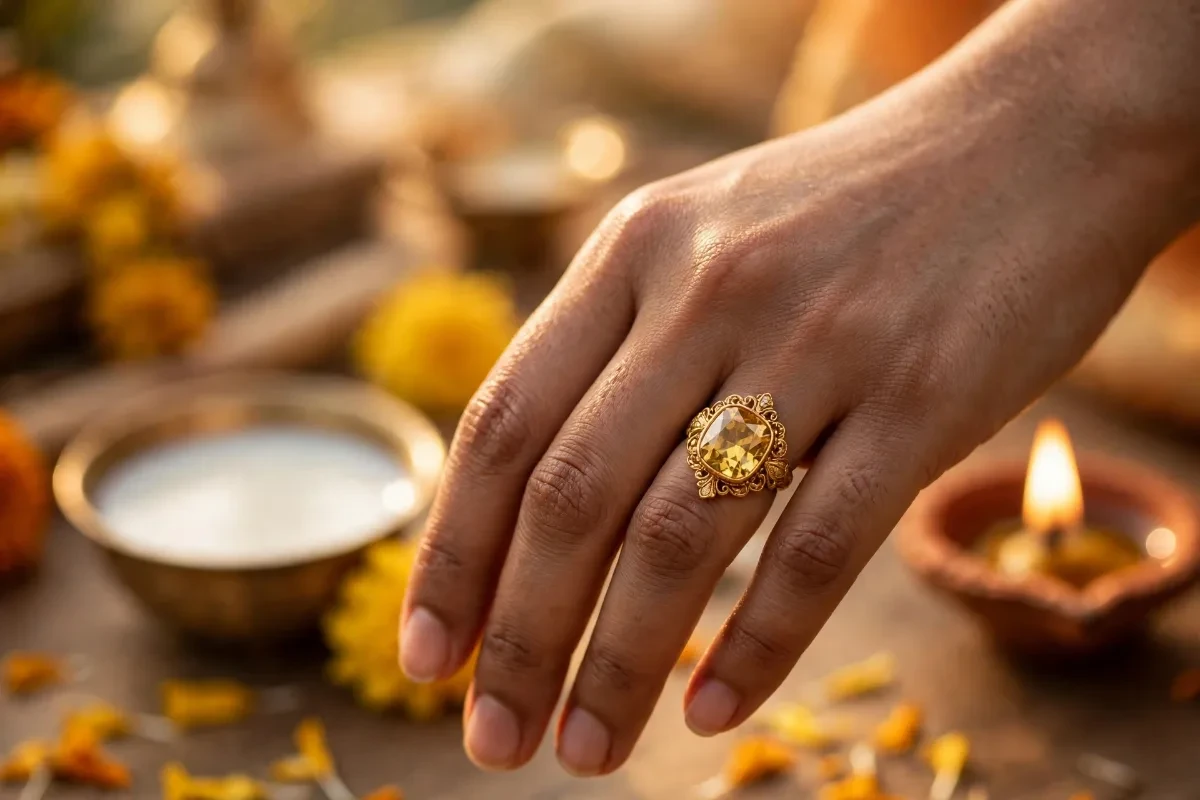

None of these steps substitute for the chart reading itself. The ritual matters to practitioners, but the decision to wear a pukhraj at all should come first. When a chart does not support a gemstone, our astrologers often point readers toward a bead remedy instead, and our 1 to 14 mukhi rudraksha guide covers that option by planet and purpose.
| Detail | Traditional guidance |
|---|---|
| Ruling planet | Jupiter (Guru) |
| Metal | Gold, or panchdhatu |
| Finger | Index finger, right hand |
| Day to start | Thursday, Shukla Paksha morning |
| Mantra | Om Brim Brihaspataye Namah |
| Typical weight | Around 1 ratti per 10 kg body weight, astrologer-adjusted |
| Common substitutes sold as pukhraj | Citrine, yellow topaz, synthetic sapphire |
| Before wearing | A kundli review to confirm Jupiter's placement and strength |
Two checks matter here, and people often do only one.
The first is gemmological. A natural pukhraj is a corundum, the same mineral family as blue sapphire and ruby, with a hardness of 9 on the Mohs scale. Citrine, by contrast, is a form of quartz, softer and far cheaper, yet regularly sold in Indian markets as "pukhraj" to buyers who cannot tell the difference by eye. Genuine natural inclusions, consistent colour under different light, and a proper refractive index reading are things a trained gemologist checks with instruments, not something a shopkeeper's assurance can replace. We tell clients plainly: ask for a certificate from a recognised lab, Indian or international, before paying for a "natural, untreated" stone. A scratch test alone proves hardness, not origin, and heated or synthetic sapphires can pass a casual look.
The second check is astrological, and it comes first in order even though people often skip straight to buying. A pukhraj bought before confirming Jupiter's role in the chart is a gamble either way, whether the stone turns out genuine or not. We would rather a reader waits a week for a proper kundli review than wears an expensive ring that never matched their chart.
Thinking about a pukhraj or another gemstone? Browse certified options in our gemstone collection once your astrologer has confirmed the fit.

| Myth | Fact |
|---|---|
| A bigger stone always works better. | Weight matters less than whether Jupiter needs support in that specific chart; a small, well-matched stone can do more than a large mismatched one. |
| Any yellow stone will do. | Citrine and yellow topaz are different minerals; they do not carry the same classical association with Jupiter. |
| Wearing it guarantees quick results. | Remedies are traditional practices rooted in faith, not a promise of a fixed outcome, and effects are described as gradual by most practitioners. |
| Everyone benefits from wearing pukhraj. | Jupiter's role shifts by ascendant; the same stone can suit one chart and sit awkwardly with another. |
| Synthetic sapphire works just as well since it "looks the same." | Classical texts refer to natural stones; a lab-created or heavily treated stone is generally held to carry a weaker or different effect. |

Consider an illustrative case, not a real client. Suppose a reader's Jupiter sits in the 9th house in Sagittarius, its own sign, but receives a hard aspect from Saturn. By the broad rule above, an already-strong, well-placed Jupiter would argue against wearing a pukhraj. But the Saturn aspect complicates it: afflicted even in its own sign, Jupiter may still need help, just not in the same way or weight as a debilitated Jupiter would.
This is exactly the kind of nuance a template article cannot resolve, and why we keep repeating the same point: the general rule and the specific chart can pull in different directions, and only a reading settles which one wins. The same logic applies to any planetary dosha in the kundli: a label alone tells you less than a full reading does.
We hear from readers across Delhi NCR, Mumbai, Jaipur, Lucknow, Bengaluru, Pune and Chandigarh asking some version of the same question: is a local jeweller enough, or do they need an astrologer too. Our answer stays the same regardless of city. A jeweller can sell you a stone. An astrologer tells you whether to buy one, and which specifications your chart actually calls for.
An online consultation works just as well as an in-person one for this purpose, since the reading depends on your birth details, not on where you happen to be sitting. Many of our clients in smaller towns, where a trained Jyotishi may not be nearby, prefer this route for exactly that reason.
Anyone whose birth chart shows Jupiter as a functional benefic that is weak, debilitated or otherwise in need of support can generally consider a pukhraj, after a kundli review confirms it. It is not a universal gemstone, and suitability depends on the individual's ascendant and Jupiter's placement.
Tradition calls for the index finger of the right hand for most wearers, since this finger is associated with Jupiter in classical palm and gem astrology. Left-handed wearers are sometimes advised to use the left index finger instead, depending on the practitioner's school.
Classical texts associate pukhraj with better decision-making, financial stability, respect from teachers and authorities, and smoother results during a Jupiter dasha. These are traditional associations tied to Jupiter's significations, not guaranteed outcomes for every wearer.
A genuine pukhraj is natural corundum with consistent colour, a hardness of 9 on the Mohs scale, and natural inclusions visible under magnification. The only reliable way to confirm this is a certificate from a recognised gemological lab, since citrine and treated stones can look similar to the untrained eye.
Pricing for a pukhraj stone varies widely by carat weight, origin, clarity and whether it is certified, and we would rather a reader get a current quote from a certified seller than rely on a number that goes stale quickly. Certified natural stones cost meaningfully more than uncertified ones of similar size.
Thursday is considered Jupiter's day and is the traditional day to begin wearing a pukhraj, ideally in the morning during the waxing moon fortnight (Shukla Paksha).
It is possible, but we would not recommend it. Wearing a gemstone tied to the wrong house or an already-strong planet can work against the chart rather than for it, by classical reasoning, so a reading first is the safer order of steps.
No. Pukhraj is a natural yellow sapphire, a form of corundum, while citrine is a variety of quartz. They can look similar in colour but differ in hardness, value and classical astrological significance, and citrine is frequently mislabelled as pukhraj in casual retail.
A pukhraj stone can be a meaningful remedy when a chart genuinely calls for one, and nearly pointless, or even counterproductive by traditional reasoning, when it doesn't. The stone itself is only half the decision; the other half is a Jupiter placement that a jeweller cannot read for you.
Start with a chart check from our astrologers to find out whether your chart calls for a pukhraj stone at all. If your reading points toward one, our complete kundli report goes deeper into Jupiter's placement, dasha timing and the houses it rules, so you are not guessing at weight, metal or timing either.
Disclaimer: Astrology offers guidance based on traditional Vedic principles. It is not a substitute for medical, legal, financial or psychological advice, and no astrologer can guarantee an outcome.