
Key points at a glance
Your cousin's rishta has just been fixed, the family pandit has asked for the kundli, and someone hands you a printout full of boxes, numbers and symbols. Or maybe your own chart has been sitting in a drawer since your naamkaran (naming ceremony), and you have never known what to do with it. We hear this from readers every week, so we wrote a plain guide on how to read kundli for people who have never opened one. If the houses are new to you, our explainer on the 12 houses in Vedic astrology is a good companion to keep open beside this one.
Generate your free chart first: Get your kundli on HealAstro
Learning how to read kundli means working through a birth chart in a fixed order: the lagna (rising sign), the Moon sign, the nine planets in their houses and signs, the aspects between them, and finally the dasha timeline. Each step narrows the picture. Skipping straight to one planet or one dosh gives a distorted result.
A kundli is a calculated chart, not a drawing of the sky. It uses your date, time and place of birth to place the nine grahas (Sun, Moon, Mars, Mercury, Jupiter, Venus, Saturn, Rahu and Ketu) across twelve bhavas (houses) and twelve rashis (zodiac signs).
Vedic astrology uses the sidereal zodiac with the Lahiri ayanamsa, which is why your Vedic sun sign often differs from the Western one you grew up reading. Classical texts such as the Brihat Parashara Hora Shastra and Phaladeepika describe the rules we still follow today.
Lagna (ascendant). This is the sign rising on the eastern horizon at birth. It becomes your first house and sets the numbering of every other house.
Rashi (Moon sign). The sign the Moon sits in. Indian families often use this for naming and for kundli milan (matching), because the Moon governs the mind and temperament.
Nakshatra. One of 27 lunar mansions, each spanning 13 degrees 20 minutes. Your Moon's nakshatra decides your starting dasha.
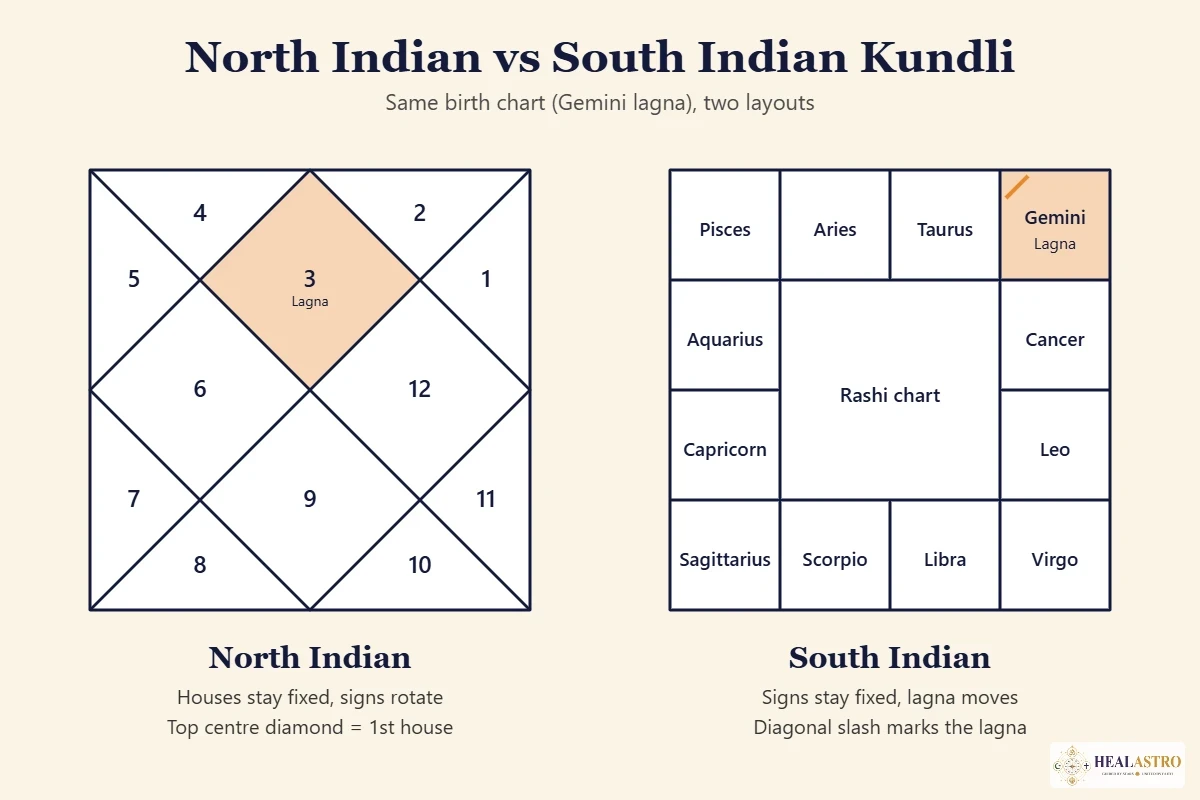
The first confusion beginners face is the layout, so settle it before anything else.
| Feature | North Indian chart | South Indian chart |
|---|---|---|
| Shape | Diamond inside a square | Square grid of 12 boxes |
| What stays fixed | Houses (top centre box is always the 1st house) | Signs (Aries is always in the same box) |
| What moves | The signs rotate based on your lagna | The lagna is marked with a diagonal line |
| How to find lagna | Look at the number in the top central diamond | Look for the box with the diagonal slash |
| Common in | Delhi, Punjab, Uttar Pradesh, Rajasthan, Bihar, Gujarat | Tamil Nadu, Kerala, Karnataka, Andhra Pradesh |
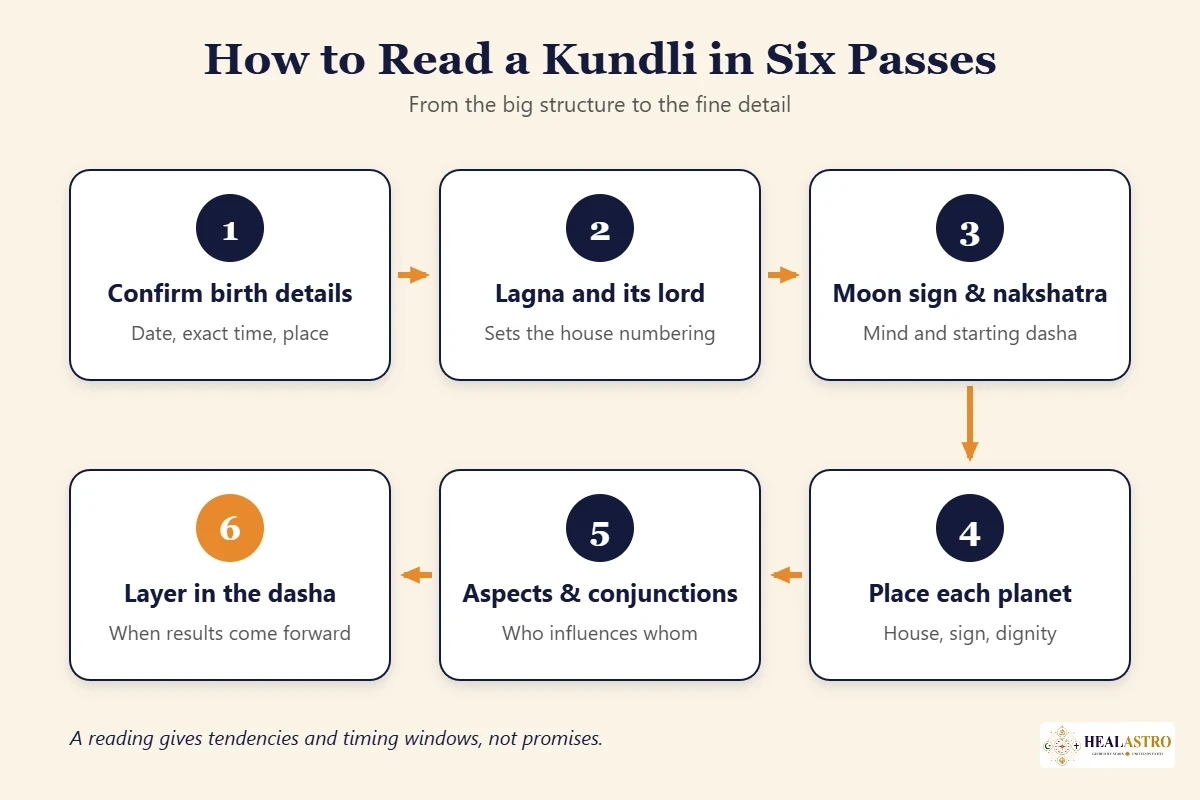
Read the chart in six passes, from the big structure to the fine detail. We follow this order with every client, and it keeps us from jumping to dramatic conclusions.
Beyond the main chart (D1, or rashi chart), astrologers use divisional charts. The Navamsa (D9) is read for marriage and the inner strength of planets, and the Dashamsha (D10) for career. Beginners learning how to read kundli should master D1 first. Our astrologers rarely open D9 or D10 until the basic chart makes sense.
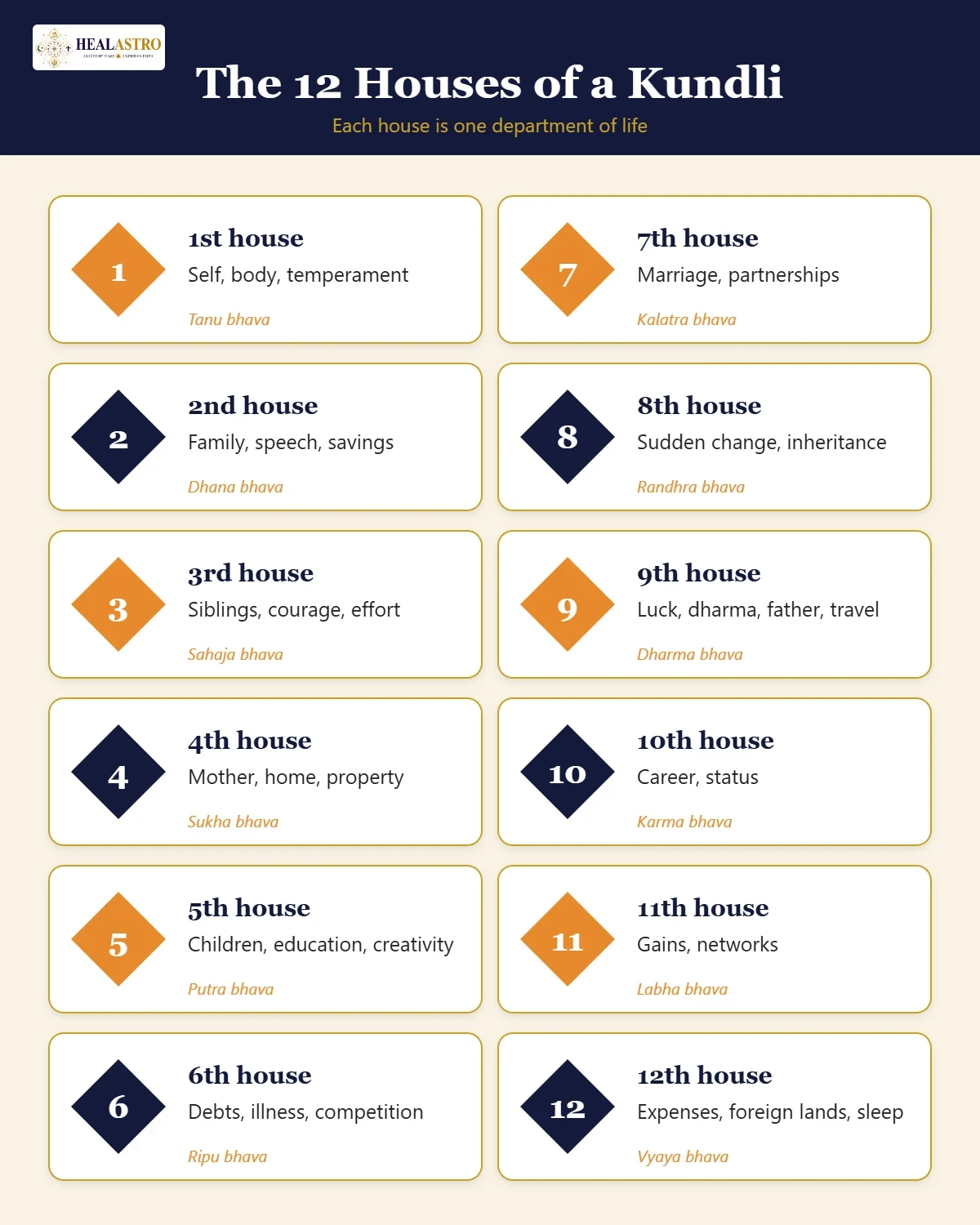
A house is a department of life, and the planets placed there decide how that department behaves. This is a quick reference; the full detail sits in our 12 houses guide linked near the top.
| House | Main themes | Quick example |
|---|---|---|
| 1st | Self, body, temperament | Mars here often gives a bold, impatient nature |
| 2nd | Family, speech, savings | Benefic planets here help steady finances |
| 3rd | Siblings, courage, effort | Strong 3rd house supports self-made progress |
| 4th | Mother, home, property | Saturn here can delay owning a house |
| 5th | Children, education, creativity | Jupiter here supports learning |
| 6th | Debts, illness, competition | Malefics here can help you win contests |
| 7th | Marriage, partnerships | Read with Venus, Jupiter and the 7th lord |
| 8th | Sudden change, inheritance | Needs careful reading, never a fear tactic |
| 9th | Luck, dharma, father, travel | Jupiter or the Sun here gives support |
| 10th | Career, status | Sun, Saturn or Mars here often marks ambition |
| 11th | Gains, networks | Most planets do well here |
| 12th | Expenses, foreign lands, sleep | Often linked to settling abroad |
Check your own chart with a trained eye: Talk to a HealAstro astrologer
Many sites say a planet in the 8th house is bad news. We disagree. House placement is only one-third of the story; the sign, the aspects and the dasha carry equal weight.
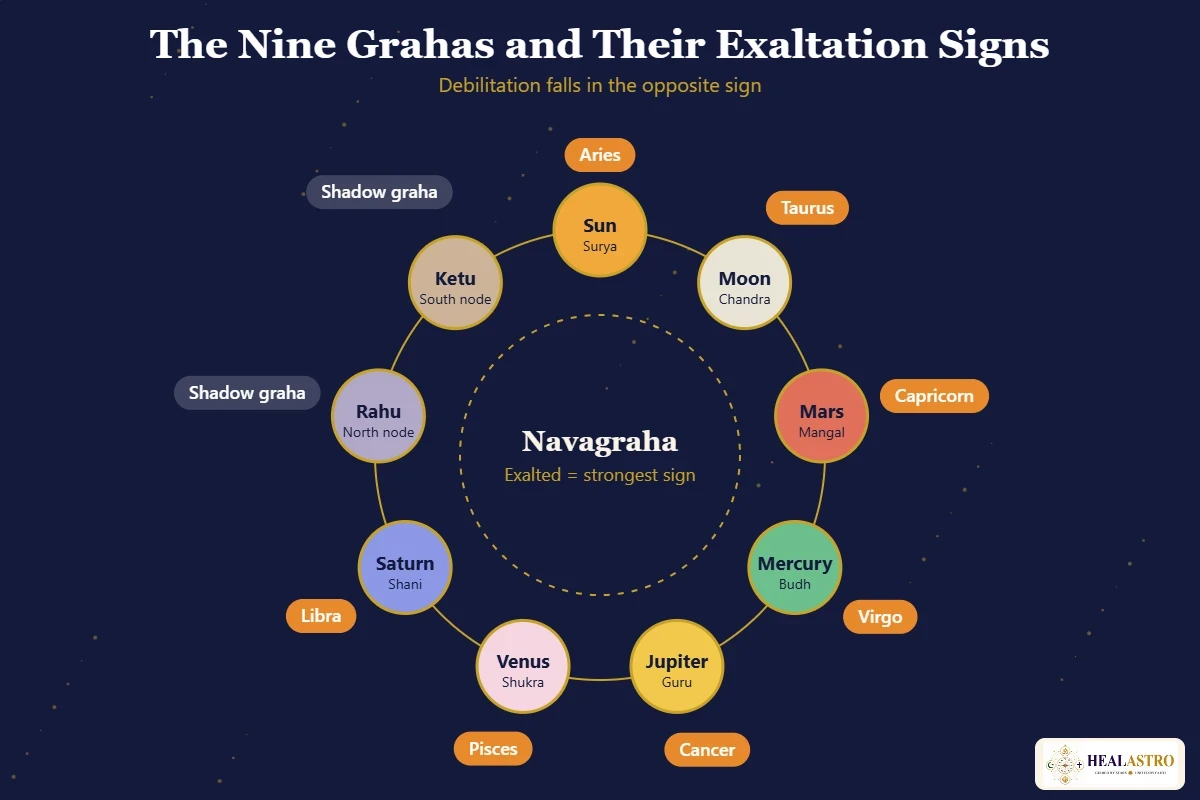
Here is how our team judges a planet in a few quick checks:
To see how the planets are moving through your Moon sign right now, check the daily horoscopes on HealAstro.
A yoga is a planetary combination that gives a specific result, such as Gajakesari Yoga (Jupiter in a kendra from the Moon) or Budhaditya Yoga (Sun and Mercury together). A dosh is a combination that creates friction, such as Manglik, Kaal Sarp or Pitra dosh.
Beginners often panic here. A printed report that says "Manglik" can ruin a family dinner. Please slow down. Mars in the 1st, 4th, 7th, 8th or 12th house is only the starting point; there are cancellations that astrologers check before calling a chart Manglik. Read our guide on Manglik dosha before drawing conclusions, and see our overview of planetary doshas in a kundali for the wider picture.
Saturn's transit over your Moon sign is another common source of worry. Sade Sati runs in three phases and does not mean seven and a half years of misfortune.
This example is illustrative and not a real client. We built it to show the method.
Take a person born with Gemini lagna and the Moon in Rohini nakshatra (Taurus). Mercury, the lagna lord, sits in the 10th house in Pisces, which is its sign of debilitation. Many online readers would flag this as a career problem and stop.
We would not. Jupiter, lord of the 10th and 7th, aspects that Mercury from the 7th house, and Mercury is not combust. That softens the debilitation. Rohini's lord is the Moon, so the person begins life in a Moon mahadasha. Later Mars and Rahu periods are where we would look closely for career decisions. The reading is a set of tendencies and timing windows, not a promise.
| Myth | What we say |
|---|---|
| A free online kundli tells you everything | It gives accurate calculations. The reading still needs a person who understands the whole chart. |
| One bad planet ruins the chart | Strength, aspects and dasha matter far more than a single placement. |
| Manglik means you cannot marry a non-Manglik | Cancellations exist, and many such matches are made after a proper chart check. |
| The Moon sign and the sun sign are the same thing | They are different. Vedic astrology leans on the Moon sign and lagna. |
| Remedies guarantee a result | Remedies are traditional practices and acts of faith. They do not guarantee an outcome. |
Here is the honest limitation. The lagna changes roughly every two hours, and the Navamsa lagna changes about every 13 to 14 minutes. If your birth time is rounded to "around 6 in the morning", the lagna may still be right, but divisional charts and dasha dates can shift. Our astrologers sometimes suggest a birth time rectification (a method of checking the time against past life events) when records are missing.
We hear from readers in Delhi NCR, Mumbai, Jaipur, Lucknow, Kolkata, Bengaluru and Hyderabad, along with many from smaller towns. A kundli is built from your date, time and place of birth, so you do not need to sit in the same room as the astrologer. Online consultation by call or chat works just as well, and you can share the screen with family members who join from another city.
Our astrologers keep remedies simple and practical:
Start with the lagna, then the Moon sign, then each planet's house and sign, then aspects, and finally the dasha. Confirm your birth time first. If you only want a quick overview, generate a free chart and note the lagna, Moon sign and current mahadasha before doing anything else.
Check the lagna (ascendant). It sets the numbering of the houses and decides which planet rules which part of your life. Without the correct lagna, every other reading becomes unreliable. A wrong birth time is the most common reason people feel their kundli "does not match" them.
Look at the layout. A diamond inside a square is a North Indian chart, where the top central box is the 1st house. A grid of twelve boxes is South Indian, where signs stay fixed and the lagna is marked by a diagonal line in one box.
You can read the Moon sign and nakshatra from the date, but not reliably the lagna, houses or divisional charts. An astrologer may try birth time rectification using past events. Treat any reading without an accurate time as a partial one.
A kundli has 12 houses and nine grahas: Sun, Moon, Mars, Mercury, Jupiter, Venus, Saturn, Rahu and Ketu. Rahu and Ketu are shadow points, not physical planets, but Vedic astrology treats them as active influences with their own dashas.
The dasha shows which planet's results are active at which age. The Vimshottari system covers 120 years and splits into mahadasha and antardasha periods. The planet in charge, along with its sign and house, decides the flavour of that phase of life.
No. Mars in certain houses creates the Manglik condition, but several cancellations exist, and the strength of Mars matters. A trained astrologer checks these before calling a chart a problem for marriage.
An astrologer reads tendencies and timing, not fixed events. Free will, effort and circumstances also shape outcomes. No honest astrologer can guarantee an outcome, and a good one will tell you where the chart is unclear.
You now know how to read kundli in a sensible order, so the next step is your own chart. If you want every planet, house, yoga and dasha explained in one document, order the Complete Kundli Report, prepared from your exact birth details. If you are curious about the next few years, our 5-Year Prediction Report maps your running and upcoming dasha periods.
Disclaimer: Astrology offers guidance based on traditional Vedic principles. It is not a substitute for medical, legal, financial or psychological advice, and no astrologer can guarantee an outcome.